
British English or American English: what should your business actually use?

I'm British, I've lived outside the UK for over a decade, and most of what I write professionally is for American clients, not British ones. That contradiction makes this question worth taking seriously rather than assuming the answer: my natural spelling barely shows up in my client work, and getting that switch right consistently is a skill in itself.
Roughly 1.5 billion people speak English worldwide, and only around 390 million of them are native speakers. That means the overwhelming majority of anyone's global audience is reading English as a second, third or fourth language, which changes the actual question. It's not "which English is correct." It's "which one signals the right things to this specific reader."
Where British English wins
The UK, obviously. But also Australia and New Zealand, most of Europe, large parts of Africa, Singapore, and India specifically. This isn't really about population, since India alone has somewhere between 125 and 265 million English speakers depending on how you count them. It's about which spelling and grammar a country's education system taught as standard.
Former Commonwealth nations were taught British English as correct, not as a foreign import
A British spelling reads as familiar to these audiences, and an American one can read as the odd one out
India, specifically, has one of the largest English-speaking populations on earth, and it's a British-English population
Where American English wins
The Americas, and a specific slice of Asia that got there through a different route entirely.
Japan, South Korea, Vietnam, Cambodia and Thailand didn't inherit American English through colonial education systems the way India inherited British English
They got there through decades of US military presence, Cold War-era alliances and the postwar spread of American business, broadcasting and film
China sits somewhere in between: American spelling dominates in textbooks and on the internet, but without the same cultural weight it carries in South Korea or Japan
The variants that don't fit either bucket
Treating this as a straight binary misses a genuine third category. Indian English, Australian English and Canadian English are established standards in their own right, not regional colour on top of British or American.
Indian English carries its own grammar conventions and vocabulary, built up over generations, not a simplified version of anything
Australian English follows British spelling but has developed its own vocabulary and register entirely
Canadian English is the odd one out worth knowing specifically: British spelling, American vocabulary, its own thing entirely
The asymmetry nobody quite admits
Brits read far more American English than Americans read British English, mostly because more US multinationals operate in the UK than the reverse. That exposure runs one direction, and so does the reaction to it.
Some Americans genuinely favour British English, enough that there's a name for it: the Downton Abbey effect, where British spelling and phrasing read as a class signal worth borrowing
Going the other way, Brits are considerably more likely to find Americanisms grating than charming
The exposure is asymmetric, and so is the affection
There's a real reason behind that asymmetry, and it goes back further than either country's marketing habits.
England has had a prestige dialect, Received Pronunciation, long before broadcasting made it a national standard, and that tradition traces back to 1066: the Norman Conquest split England along class lines that the language never fully shook off.
The United States was founded in 1776 as a direct rejection of exactly that kind of inherited hierarchy, noble titles included, and its relationship to language reflects it. America has a general prestige register, but nothing enforced with the same cultural weight as Received Pronunciation. One country built a linguistic class marker into its history. The other wrote a rejection of class into its founding document.
That's not a small cultural footnote; it's largely why the asymmetry exists at all.
Even the sales tone differs along the same lines.
As George Bernard Shaw is credited with saying, "England and America are two countries divided by a common language." American copy tends to sell directly. British copy tends to persuade sideways. Neither is wrong, but swapping one register into the other market's content reads as slightly off, in a way most readers can't articulate but definitely notice.
What actually changes on the page
Vocabulary shifts more than people expect; spelling is the most visible layer, and grammar differs more subtly than either:
Vocabulary: holiday versus vacation, trainers versus sneakers, petrol versus gas, nappies versus diapers
Spelling: colour versus color, optimise versus optimize, organise versus organize
Grammar: "Monday to Friday" against "Monday through Friday," or "the team is" against "the team are"
None of these causes real confusion on their own. What they reliably signal is which side of the Atlantic actually wrote the copy.
Winston Churchill ran into this directly during the Second World War.
The British Chiefs of Staff wanted to "table" a plan in talks with their American counterparts, meaning to propose it for discussion. To the Americans in the room, tabling something means the opposite: taking it off the table and ending the discussion. One word, two meanings, a genuinely consequential mix-up between allies mid-war.
The one rule that matters more than which one you pick
Consistency. Pick one and hold the line across the entire site, not just the homepage.
Mixing colour and color in the same piece of writing looks careless in a way that's disproportionate to how small the error actually is, and it's the one mistake that reads as sloppy regardless of which audience is reading it.
This isn't just my own view. It came up independently, unprompted, from two different professional writers discussing the exact same question: don't mix colour and color in the same piece of prose, full stop. When two people arrive at identical advice from different directions, it's usually because the advice is simply correct.
Writing a neutral "mid-Atlantic" version that dodges both doesn't solve this either. It's genuinely hard to write, and the result reads stilted, satisfying nobody on either side.
Default to the dialect of your primary audience, not your own
Switch deliberately for a specific job, not by accident partway through one
One professional translator put it plainly when asked how he handles this for international clients: default to British English unless the audience is specifically American, Australian or otherwise, then switch for that job — not because British English is more correct, but because consistency has to start somewhere
I put the question to my own network directly, out of curiosity rather than any pretence at a proper study. 66% write their business content in British English, 26% in American, 6% mix the two, and nobody picked Australian or Canadian.
That's a small, self-selected sample, mostly people connected to me professionally, not a claim about the wider working world. But it lines up with the default the translator above described: British unless the audience gives you a specific reason to switch.
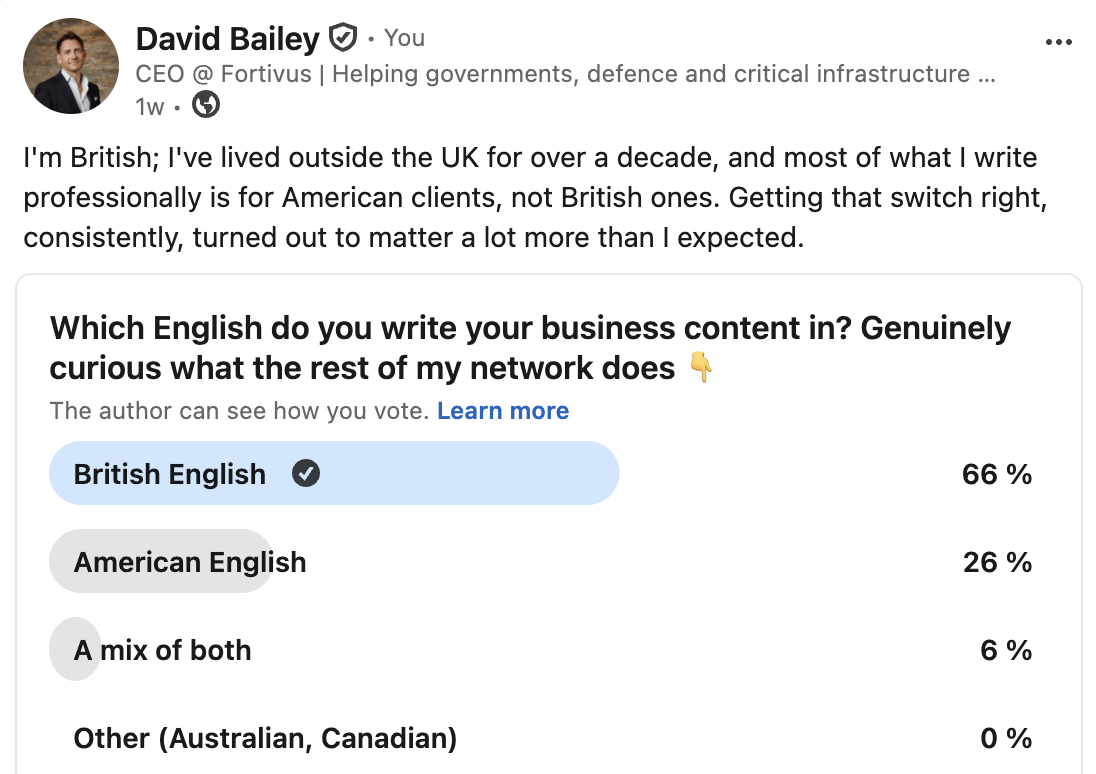
British English or…?
This is also a technical SEO decision, not just a style one
Four things worth acting on, specifically:
Ecommerce product copy needs the actual keyword, not a stylistic preference — "trainers" and "sneakers" are different keywords with different search volumes, and the wrong one makes a product invisible for exactly the term your buyer typed. Get this right, and it shows up. Get it wrong, and it doesn't, regardless of how well the rest of the page is optimised.
Local landing pages need the terminology and spelling their searchers actually use, not just the city name dropped into a generic template. A local SEO page for London and one for Boston shouldn't use the same copy with only the place name swapped in.
hreflang tagging for en-GB, en-US and en-AU needs to treat them as genuinely separate targets, using the same technical discipline that applies across languages, applied within one language instead. Skip it, and both versions quietly compete against each other rather than each doing its job.
Readability sits alongside dialect, not underneath it. Blu Mint's own research into Flesch reading ease scores puts the ideal range for web content at 60 to 70, reachable in any English variant through shorter sentences and plainer words. Good SEO copywriting treats dialect and readability as two separate checks on the same piece, not one.
Handling all four together, rather than as separate jobs handed to different people, is really what a content writing agency is for.
Where Blu Mint’s writers can help
We wrote about this exact question years ago from a completely different angle, arguing that being a native speaker doesn't automatically make someone a better English teacher, or a better writer.
If native speaker status were a genuine prerequisite for teaching English well, roughly 80% of the world's English teachers would count as unqualified, which is obviously absurd once you say it plainly
Non-native speakers often understand English grammar more explicitly than native speakers do, because they had to learn the rules rather than absorb them by accident
Even inside the Blu Mint team, the people writing this content are a mix of British, American, Estonian and other backgrounds, all working in English, all sounding at least slightly different from each other on the page
That mix is the actual, practical reason we can write fluently in either dialect rather than defaulting to one and hoping it lands.
If your business is trying to reach more than one English-speaking market, that's not a find-and-replace job between colour and color. It's a proper localisation decision, and it's worth getting the reasoning right before you write a single word.
Get in touch if that's the position you're in.
-
It depends on which market your audience's education system was built around. Former Commonwealth nations, Australia, New Zealand, most of Europe, large parts of Africa, Singapore and India, were taught British English as standard. Japan, South Korea, Vietnam, Cambodia and Thailand adopted American English instead, largely through decades of US military presence and postwar cultural influence rather than colonial education.
-
No, and treating them that way is a real mistake. Indian English carries its own grammar conventions and vocabulary built up over generations. Australian English follows British spelling but has developed its own vocabulary entirely. Canadian English mixes British spelling with American vocabulary, genuinely its own thing rather than a blend of the other two.
-
No, consistency matters more than which one you actually pick. Mixing colour and color in the same piece of writing reads as careless in a way disproportionate to how small the error is. Default to your primary audience's dialect, and switch deliberately for a specific job, not by accident partway through one.
-
Yes, directly. Ecommerce product copy needs the actual keyword a buyer searches, trainers and sneakers carry different search volumes entirely. Local landing pages need the terminology searchers actually use, not a generic template with the city name swapped in. hreflang tagging for en-GB, en-US and en-AU needs the same technical discipline used across languages, applied within one language instead.
