
AI search optimisation
Get cited by AI, not just ranked by Google
AI tools now answer billions of questions a month, often without a single click through to a traditional search result.
Being the source ChatGPT, Gemini or an AI Overview actually cites is quickly becoming as valuable as ranking first on Google used to be.
Here's the part most agencies won't tell you plainly: this isn't a separate discipline built from scratch; it's roughly 95% the same fundamentals good SEO has always required, and about 5% platform-specific nuance layered on top.
What is AI search optimisation?
How do the major AI platforms actually source answers
Is AI search optimisation right for you?
AI Search is built on SEO foundations
What is AI search optimisation?
Answer engine optimisation, generative engine optimisation, AI optimisation, AEO, GEO, AIO- whatever term you've seen it called- it's the same underlying shift.
AI tools like ChatGPT, Gemini, Claude and Perplexity are increasingly where people research before they buy and being cited inside those answers is becoming as valuable as ranking on page one used to be.
Here's what most agencies won't tell you plainly. This isn't a new discipline built from scratch.
It's roughly 95% the same fundamentals as good SEO always required: genuinely useful content, real backlinks, solid technical foundations, and about 5% platform-specific nuance on top.
Google's own Search Advocate has said publicly that there's no such thing as GEO or AEO without SEO fundamentals underneath it.
We agree, and we've built our service around that reality rather than selling you a separate methodology that doesn't exist.
How the major AI platforms actually source answers
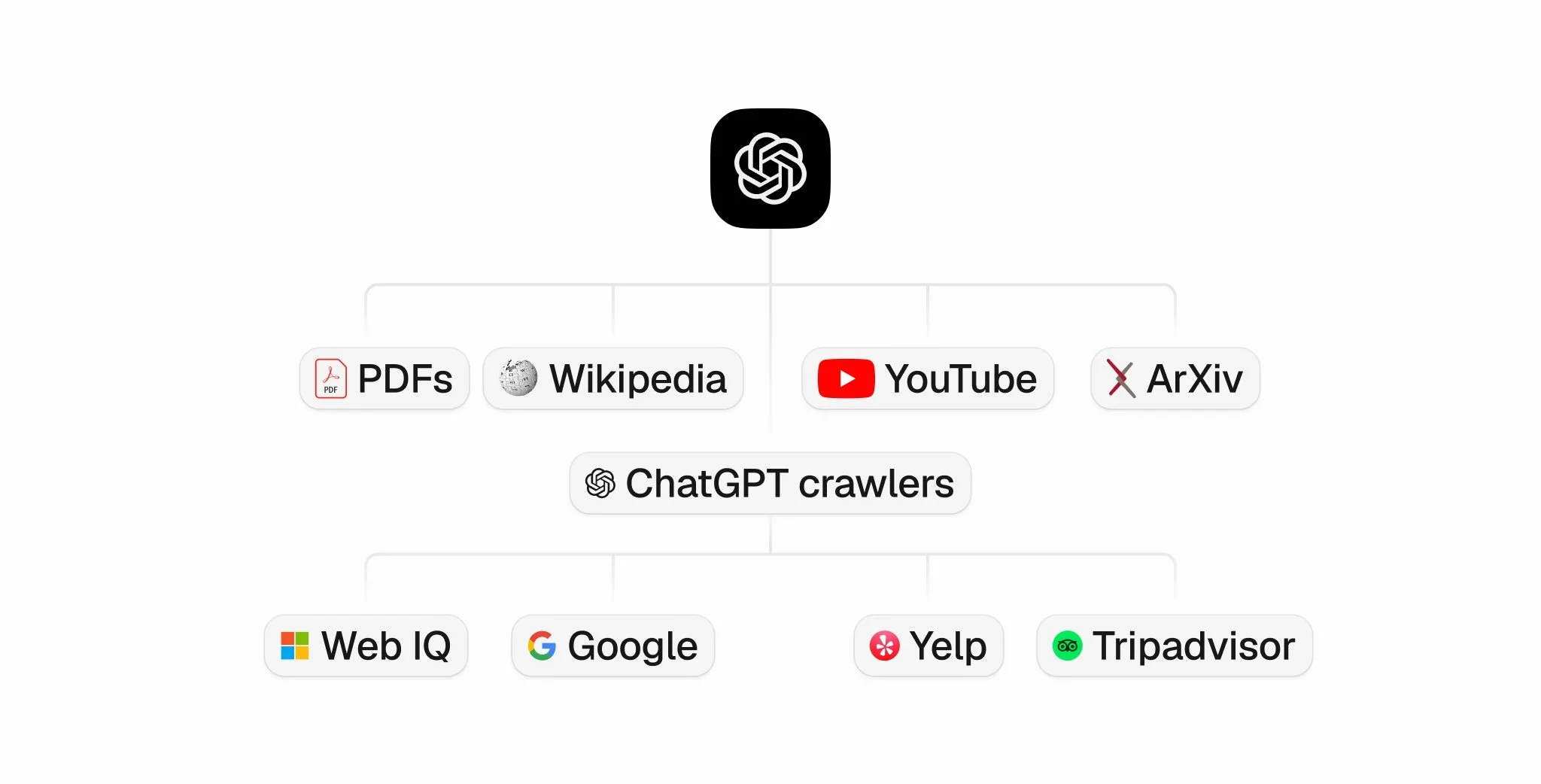
AI assistants mostly don't crawl the web themselves; they draw on existing search indexes, and each one leans on a different one.
| AI platform | Underlying search index | What this means |
|---|---|---|
| Google AI Overviews | Google Search | Appears directly in Google's results page, grounded in multiple sources per sentence, standard Google SEO is the most direct lever here |
| ChatGPT | Bing | Ranking well in Bing meaningfully affects ChatGPT visibility |
| Gemini | Standard Google SEO carries directly into Gemini results | |
| Claude | Brave / Bing | Brave's index and standard SEO fundamentals both matter |
| Perplexity | Multiple sources, blended | Broad, well-established visibility across sources matters most |
Is AI search optimisation right for you?
Being cited by AI isn't a nice-to-have anymore; it's quickly becoming a real channel buyers use to shortlist vendors before a traditional search ever happens. A few signals suggest it's worth prioritising now, not later.
Competitors are showing up in ChatGPT, AI Overviews or Perplexity answers for terms you'd expect to own, and you aren't
Your SEO fundamentals are solid, but you have no visibility into whether AI tools are citing you at all
Prospects have mentioned finding a competitor through an AI assistant rather than a traditional search
AI Search is built on SEO foundations

What stays exactly the same
Genuinely useful content. Entity-rich, well-structured, accurate content performs well in both traditional search and AI citation because it's easier for humans and machines to parse and trust.
Real backlinks. Earned links remain a trust signal for search engines and, by extension, AI systems that draw on those same indexes still weight them heavily.
Technical foundations. Site speed, clean structure and proper indexing still matter. AI visibility doesn't bypass technical SEO; it depends on it.
What's genuinely different
Source trust varies by platform, and it's not always what you'd expect. Independent testing has found that Reddit, despite ranking extremely well in Google, gets rejected as a citation source by LLMs more than 90% of the time. Platform-level trust doesn't map directly from traditional rankings.
Serving format can matter. Research from Cloudflare found that AI crawlers preferentially cite content served as plain markdown over content wrapped in heavy HTML and scripting, a genuinely new, platform-specific consideration that didn't exist in traditional SEO.
Grounding behaviour differs by platform. Google grounds AI Overview responses in multiple search sources per sentence. OpenAI tends to ground more sparingly, often one source per claim. Understanding this affects how confidently content needs to stand on its own.
Speed of impact, not the mechanism. The biggest genuine difference isn't a new set of tactics; it's the timeline. Content that once took twelve to eighteen months to build authority can now influence AI citations within days of publication.
What we don't do
Some tactics get pushed hard in this space right now with little evidence behind them.
Listicle-heavy content is one; some practitioners claim it performs disproportionately well for AI citation, when the more likely explanation is that current AI systems are still relatively unsophisticated at parsing more complex content structures, not that listicles are a genuine long-term strategy.
As AI systems mature, content built purely to exploit a current parsing limitation is likely to lose whatever edge it has. We build for durability, not a temporary gap in how the technology currently works.
Read more about search engine optimisation →
FAQs
-
Functionally, very little. AEO (answer engine optimisation), GEO (generative engine optimisation) and AIO (AI optimisation) are largely overlapping terms different parts of the industry have coined for the same underlying shift, optimising for AI-generated answers rather than only traditional search rankings.
-
No, and we don't sell it as one. It's built into every SEO engagement as standard, since the two are too interconnected to separate honestly. The platform-specific nuances get layered on top of a genuine SEO foundation, not sold as a standalone package.
-
It's included in our SEO services at no additional cost. If a business were charging separately for "AEO" as an entirely distinct service, that's usually a sign they're selling hype rather than substance.
-
No, and any agency that guarantees AI citation isn't being straight with you. What we can do is build the genuine fundamentals, content quality, backlinks, technical structure, plus the specific platform nuances that give you the best realistic chance of being cited.
-
Faster than traditional SEO used to move. Where authority-building once took twelve to eighteen months to show up in rankings, AI citation can shift within days to weeks of a genuine content or authority change, though sustained, consistent work still matters more than any single quick win.
If you want AI search visibility built on real fundamentals, not tricks that stop working the moment the platforms catch up, get in touch to speak with David, our SEO and AI strategist.

Contact us online to chat with David, our senior SEO & AI Search strategist.
Articles




An SEO strategy is a roadmap for Search Engine Optimisation activities with definitive steps to dominate rankings from your competitors. But how is it done?