ChatGPT Business Hub is OpenAI's free dashboard for claiming your business profile in ChatGPT and seeing how often ChatGPT refers to you. I claimed Blu Mint and Fortivus from Estonia in under an hour each. The biggest lesson is that the business type you end up with decides what gets counted. Fortivus, set up as an online business, showed 58 mentions over the past 28 days, while Blu Mint, claimed as a local place, showed none.
I only set both profiles up this week, so I don't really know how this will work out yet. I'll update this article as I keep experimenting.
Post summary:
What is ChatGPT Business Hub?
How I claimed Blu Mint and Fortivus
Place or website, why the business type matters
What the insights count, and what they miss
ChatGPT Business Hub vs Google, Apple and Bing
Should you claim your business in ChatGPT?
Can an agency claim it for you?
What is ChatGPT Business Hub?
OpenAI launched Businesses in ChatGPT in beta on 10th November 2026, and Business Hub is the dashboard behind it.
From Business Hub you can claim and verify your profile, correct your details, add a product feed and see insights covering mentions, profile views, website clicks and discovery topics.
OpenAI aimed the launch at "the 1.2 billion people who use ChatGPT each week", according to Dynamic Business.
That audience already uses AI to choose who to buy from. BrightLocal's Local Consumer Review Survey 2026 found that 45% of consumers used ChatGPT or other AI tools for local business recommendations, up from 6% the year before.
ChatGPT alone was used by 31% of consumers for business recommendations, compared with 23% for Google AI Mode, according to a breakdown of the same survey.
Source: BrightLocal Local Consumer Review Survey 2026, 1,002 US adults.
Being recommended is still rare. SOCi's 2026 Local Visibility Index, which analysed over 350,000 locations, found that ChatGPT recommends just 1.2% of local businesses.
The beta also includes Business Agents, which chat with customers inside ChatGPT. For now, they're limited to eligible US ecommerce and online service businesses, and companies can sponsor them as ChatGPT ads.
How I claimed Blu Mint and Fortivus
I claimed both businesses from Estonia. OpenAI says any eligible business located where ChatGPT is available can claim a profile.
Blu Mint was already listed in ChatGPT, so I searched for it and claimed the existing listing. Fortivus wasn't listed, so I created it from its website.
The search shows any listings ChatGPT already has, with an option to create a new business above them.
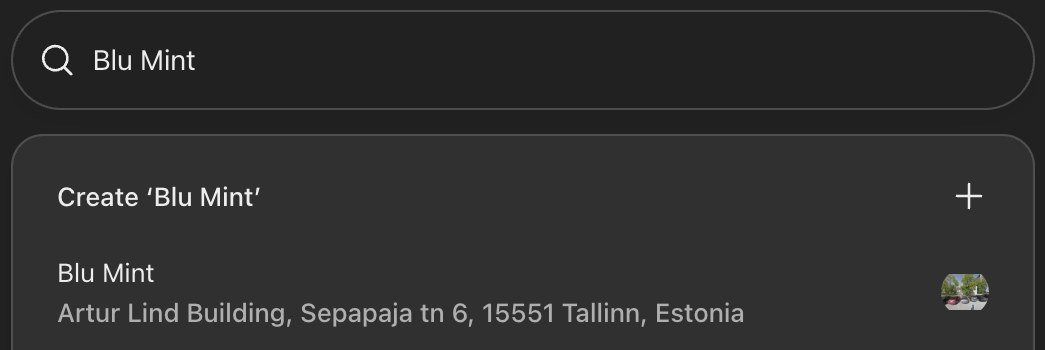
Searching for Blu Mint in ChatGPT Business Hub, with the option to create a new business above the existing Tallinn listing
The process has four steps.
Find or add your business. Open Business Hub from the ChatGPT sidebar, or go to chatgpt.com/business-hub, and search by name.
Prove you're connected to it. Depending on the business, OpenAI offers a business phone number, email address, website domain or Shopify account.
Verify your identity with Persona. OpenAI requires this before you can publish changes, view insights or create a business agent.
Complete your profile. Add your category, description, contact details, photos, location and hours.
I tried the phone first. ChatGPT offered Blu Mint's Estonian business number, but it couldn't send a text to it, and the attempt ended without completing the claim.
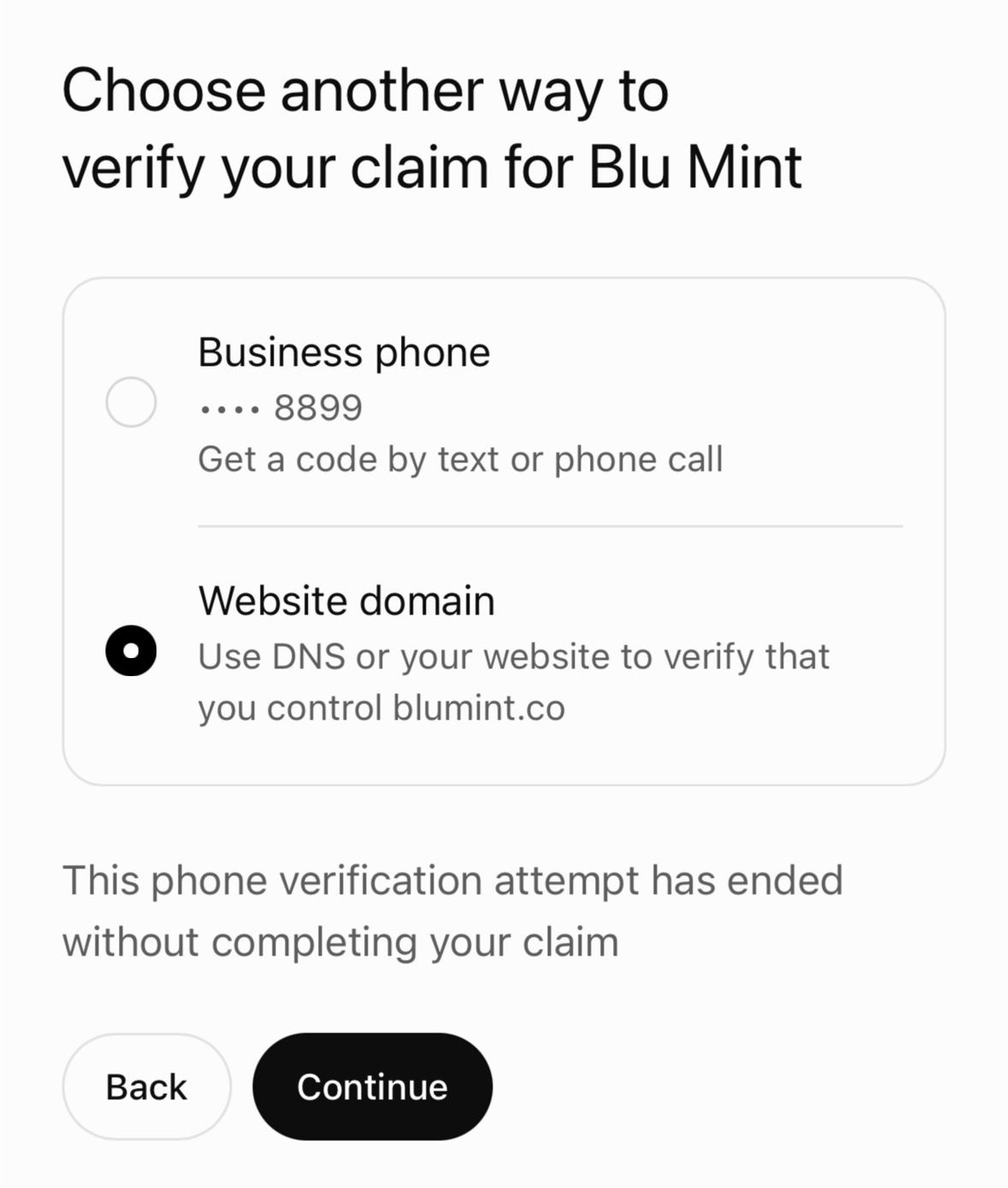
ChatGPT Business Hub screen offering business phone or website domain verification for Blu Mint
So I switched to the website domain. ChatGPT gave me a TXT record to add to our DNS, with the host name openai-business-claim and a code that expired after 24 hours.
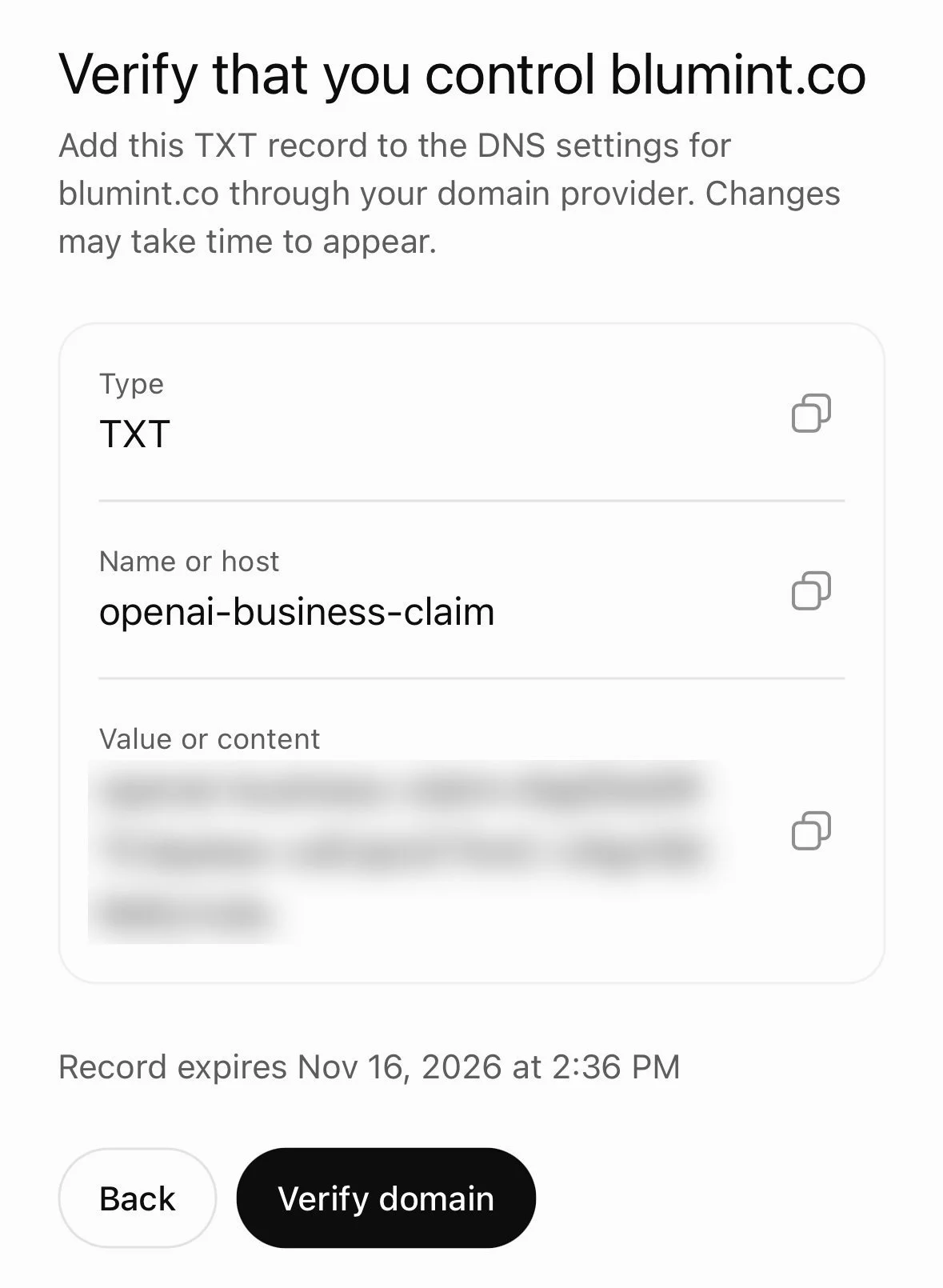
ChatGPT Business Hub TXT record for verifying the blumint.co domain, with the code blurred
I added the record in IONOS, where our domain is registered, and went back to ChatGPT to click Verify domain.
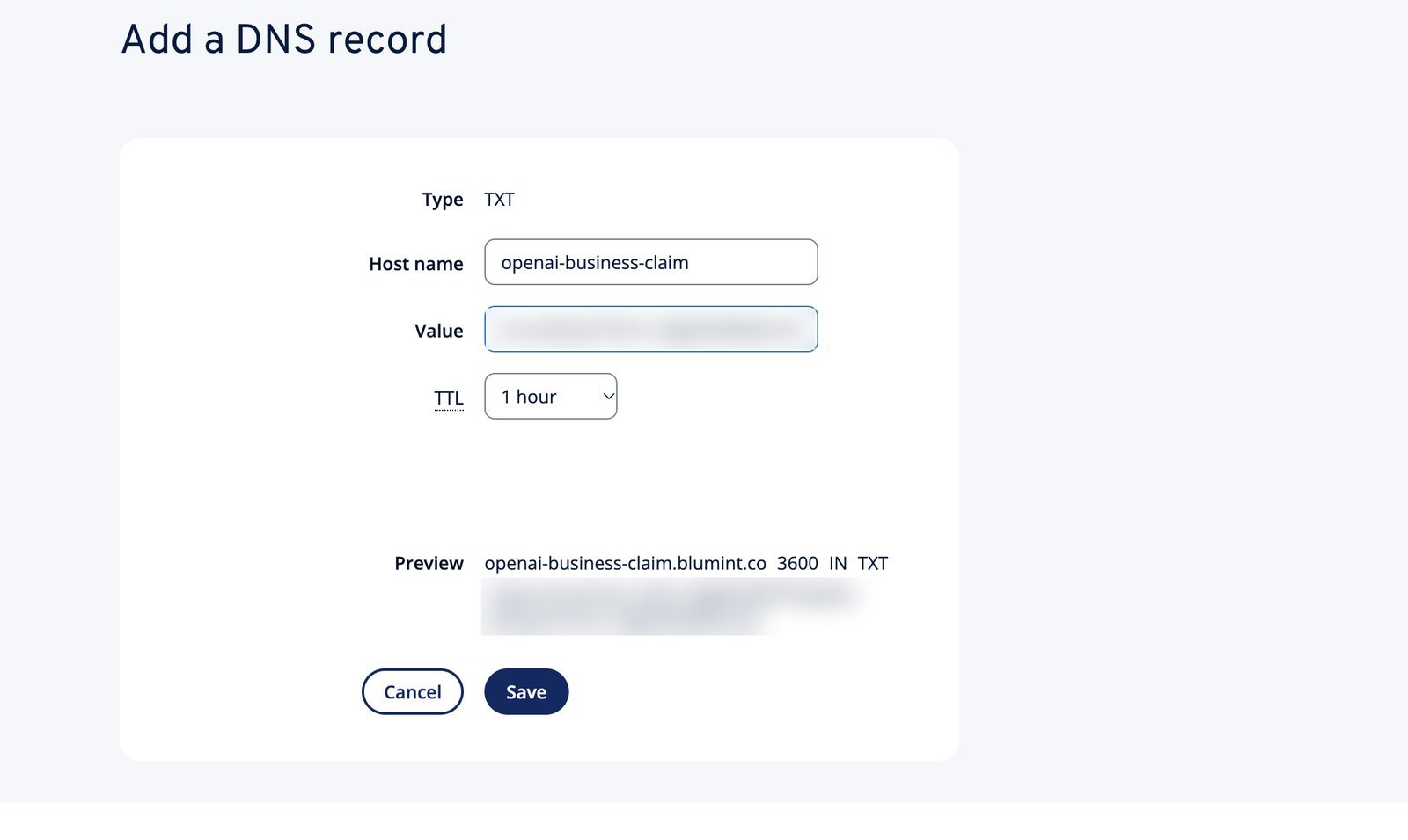
Adding the openai-business-claim TXT record in the IONOS DNS settings
The identity check took the most effort. Persona asked for my UK passport and a face scan, where I had to turn my head from side to side.
Once that was approved, I could edit each profile. The business details screen covers your category, a description, contact details, photos, location and hours.
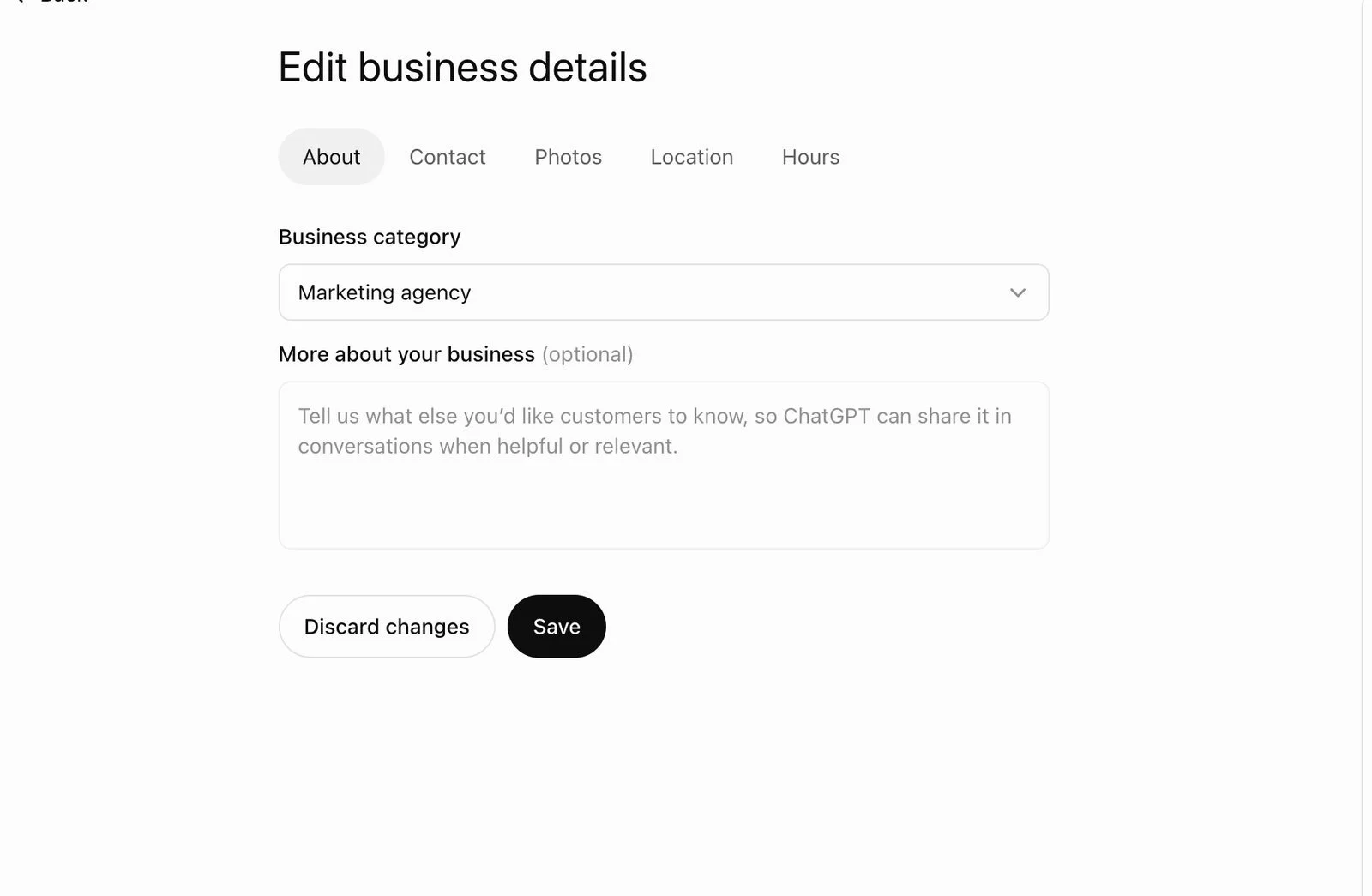
Edit business details screen in ChatGPT Business Hub with the category set to marketing agency
Each claim took less than an hour from start to finish, passport check included.
Place or website, why the business type matters
Because Blu Mint was already in ChatGPT as a place, it came through as a local business with our Sepapaja 6 address in Tallinn. Fortivus, which I created from its website, became an online business.
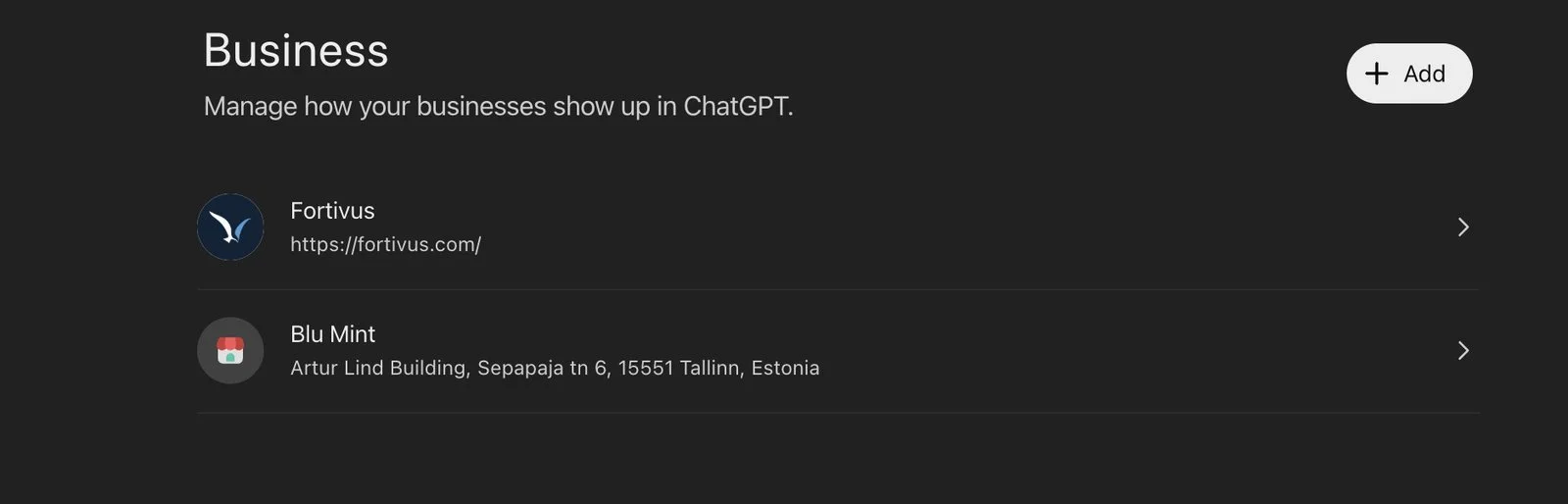
ChatGPT Business Hub list showing Fortivus as an online business and Blu Mint as a local business with a Tallinn address
That one difference changed what each dashboard tracks.
Fortivus showed 58 mentions and one website click over the past 28 days. Its daily figures go back to 18th October, weeks before I claimed it.
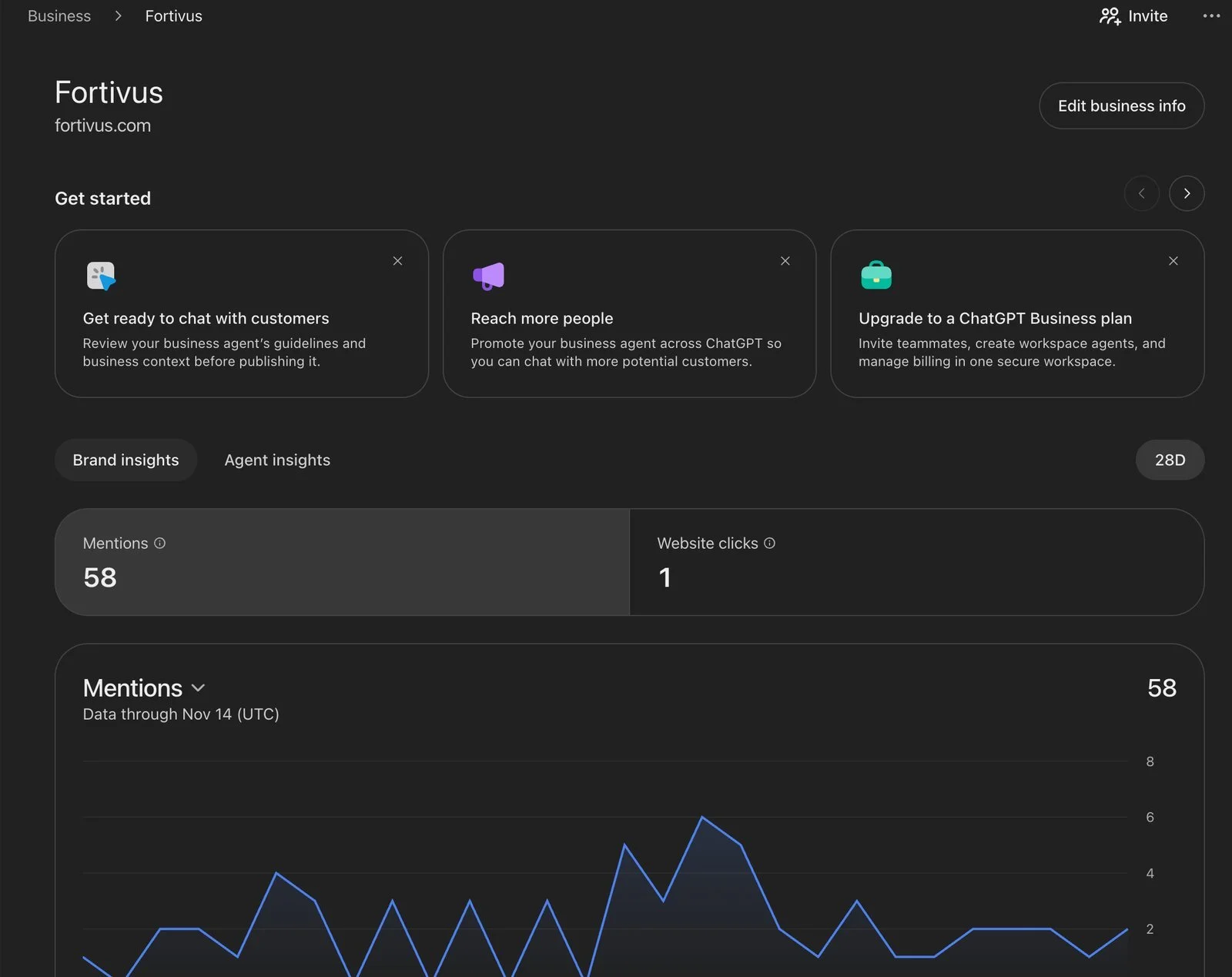
Fortivus brand insights in ChatGPT Business Hub showing 58 mentions and 1 website click over 28 days
Blu Mint showed nothing at all. Every panel carried the same message, "Once there are enough mentions, you'll see trends here."
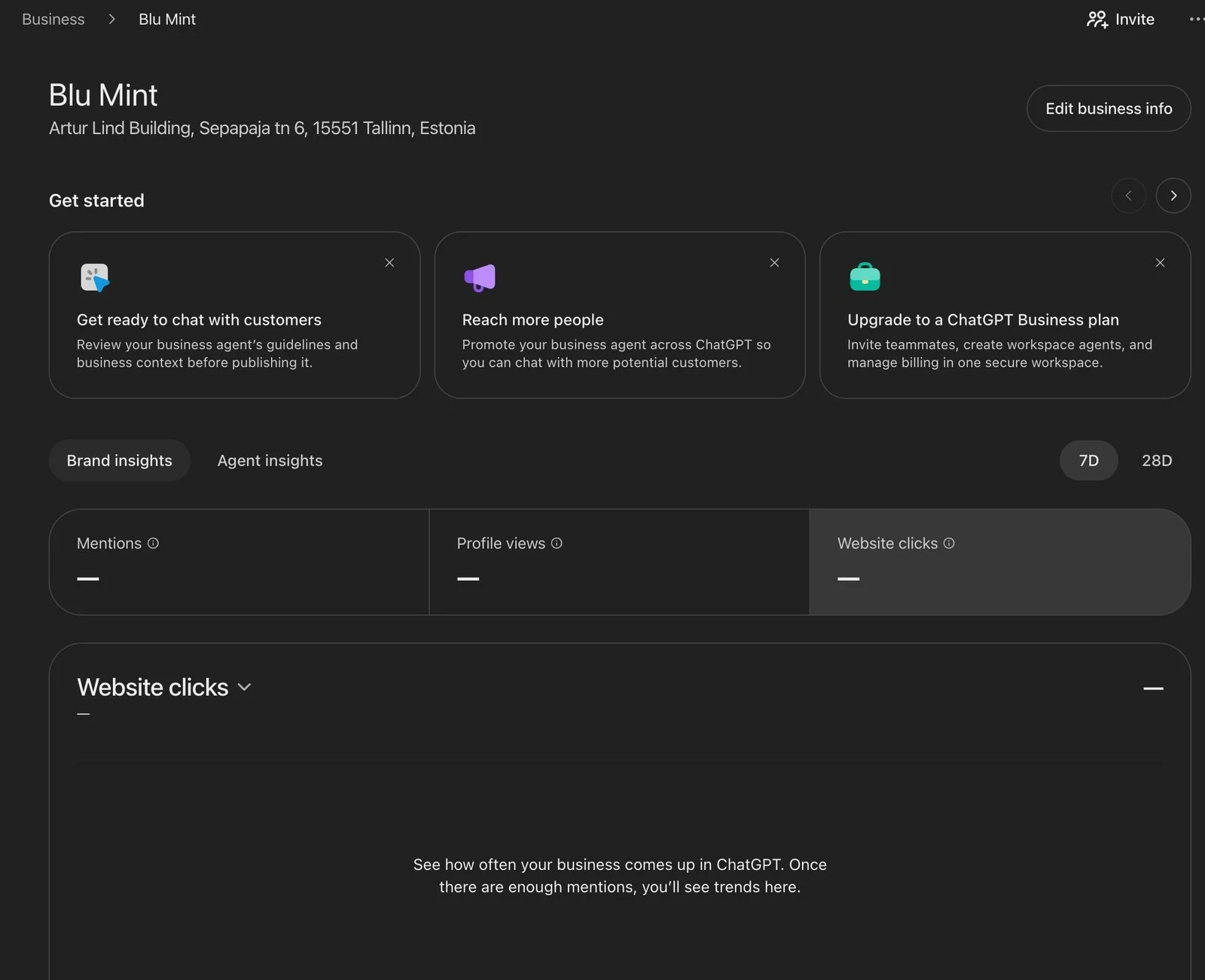
Blu Mint brand insights in ChatGPT Business Hub showing no mentions, profile views or website clicks yet
OpenAI's help centre explains why. For an online business, a mention counts when ChatGPT references the business's website, and "the brand name alone doesn't count".
For a local business, a mention only counts when ChatGPT shows a result for that location, even if nobody opens it.
Going by that definition, ChatGPT citing a Blu Mint article doesn't register on our local listing. The dashboard only moves when ChatGPT shows our office as a place.
Our local listing does include blumint.co as its website, so website clicks still count. It's only the mentions that depend on ChatGPT showing the location.
Local listings do get one extra metric. Blu Mint's dashboard includes profile views, which the Fortivus dashboard doesn't show.
There's also a regional quirk. Third-party guides quoting OpenAI's help centre say local stores and restaurants can only claim existing US listings for now. Blu Mint isn't a shop or restaurant, and our Tallinn listing went through without a problem.
Both dashboards also show website access as confirmed. While you're checking yours, make sure your robots.txt allows OAI-SearchBot, because OpenAI says sites that opt out of it won't be shown in ChatGPT search answers.
If your business works mainly online and you have the choice, create the profile from your website. I've left Blu Mint's verified local listing as it is for now, rather than risk breaking it.
What the insights count, and what they miss
Insights show aggregate activity over the past 28 days, and you can switch to a seven-day view.
Website clicks are "recorded clicks on links to your website in ChatGPT", and OpenAI warns that clicks don't confirm visits or conversions, as Search Engine Roundtable reported.
Discovery topics show the common themes in conversations where your website is cited. Fortivus has 58 mentions and still no topics, so you need a fair amount of activity before any appear.
For an online business, Business Hub's mentions are closer to citations than brand mentions, so they sit naturally alongside wider AI citation tracking.
Business Hub doesn't show prompts, share of voice or competitor rankings. Treat it as one more data source next to Search Console and GA4, not a replacement for either.
ChatGPT Business Hub vs Google, Apple and Bing
Most businesses already manage listings on Google, Apple and Bing. Here's how Business Hub compares.
| ChatGPT Business Hub | Google Business Profile | Apple Business | Bing Places | |
|---|---|---|---|---|
| Where you appear | ChatGPT answers and business profiles | Google Search and Maps | Apple Maps, Mail, Wallet, Siri, Safari and Spotlight | Bing search and Bing Maps |
| Built for | Online businesses with a website, plus existing local listings | Local and service-area businesses | Businesses with a place on Apple Maps, plus brand and device tools | Local businesses |
| How you verify | Business phone, email, website domain or Shopify, then a Persona ID check | Video recording most often, or phone, email or postcard | Domain TXT record, among other methods | Sync from a verified Google Business Profile, or phone, email or postcard |
| Insights | Mentions, profile views, website clicks and discovery topics | Searches, views, calls, directions and website clicks | Searches, views and taps on actions in Maps | Listing performance in the Bing Places dashboard |
| Cost | Free during the beta | Free | Free | Free |
For Bing, I didn't verify anything by hand. I synced Bing Places with Google Business Profile, and all 16 profiles I manage for clients were copied across that way.
The table draws on OpenAI, Google verification methods, Apple Business and Bing Places.
Should you claim your business in ChatGPT?
Yes, I think it's worth doing.
The main reason is protection. Barry Schwartz at Search Engine Roundtable raised the risk of businesses being hijacked through false claims. Claiming your profile first stops someone else from getting there before you.
If someone does claim yours, OpenAI has a dispute ownership process that runs through the same Persona check.
The second reason is the chance of new citations. It's too early to tell whether a claimed profile changes how often ChatGPT cites you, but at least you can now see OpenAI's own count.
Claiming is free during the beta, so the only cost is about an hour of your time.
It's still early days, and I'll add what I learn here as I go.
Can an agency claim it for you?
Partly. At Blu Mint we will set up and manage ChatGPT profiles for our clients.
What we can't do is the identity check. Persona verifies the person going through it, with an ID document and a face scan, so the business owner or someone authorised to represent the business has to complete that step.
Other agencies have reached the same conclusion, with one guide noting that an agency generally shouldn't claim on a client's behalf.
Want your business to show up in ChatGPT?
Blu Mint helps scale-ups and enterprise brands get found and cited in ChatGPT, Google AI Overviews and other AI search tools.
Find out more about our AI search optimisation services or our wider SEO agency work, and get in touch to talk about your business.
-
Yes. Claiming your business, managing your profile and viewing insights in ChatGPT Business Hub are free during the beta. Business Agents can be promoted as paid ChatGPT ads.
-
Yes. OpenAI says any eligible business located where ChatGPT is available can claim a profile, and I claimed two businesses from Estonia. Business Agents are limited to eligible US ecommerce and online service businesses for now.
-
It depends on your business type. For an online business, a mention only counts when ChatGPT references your website, not your brand name. For a local business, it only counts when ChatGPT shows a result for your location. Insights also need a minimum amount of activity before they appear.
-
You need a way to prove your connection to the business, such as a business phone number, business email, a DNS record on your domain or a Shopify store. You also need to pass an identity check with Persona. I used my UK passport and a short face scan.