
Getting cited by AI Overviews: AEO for content teams
Answer engine optimisation (AEO) is the practice of structuring content so AI answer engines — Google's AI Overviews, ChatGPT, Perplexity, Gemini — cite it directly rather than merely ranking it. That's the short version. The longer version is that the entire economics of the web have flipped, and most content teams are still reporting on the old ones.
Conductor's own Search Console data makes the point better than any theory could: AI crawlers now visit sites thousands of times while sending back little or no traffic. Impressions climb, clicks fall.
As Pat Reinhart, VP of Services at Conductor, put it in a recent Search Engine Journal webinar, the goal now "is not traffic, because traffic is going to naturally go down as people are educating themselves on LLM surfaces." If your dashboard still leads with organic sessions, it's measuring the wrong century.
We've written before about the scale of that shift — 58% of searches now end without a click, and AI traffic converts at roughly 8.7% against 0.8% for low-quality organic. What's changed since then is that the research has gone from directional to genuinely granular: multiple independent studies now show, factor by factor, exactly what separates a page that gets cited from a page that merely ranks.
This piece goes through what that newest research actually says, and what a content team should do differently as a result.
The prerequisite nobody wants to hear: you still have to rank
There's a comforting theory going around that AI search is a separate game — that you can skip the grind of organic rankings and optimise your way straight into AI answers. The data doesn't support it.
Surfer's research, based on over 650,000 AI-generated answers scored against a 20-factor rubric, found that 84% of AI Overviews' top citations come from pages already ranking in the organic SERP. Only 16% are pulled from outside it. Google isn't auditioning the whole internet for every query — it's mostly picking from a shortlist its own ranking systems already assembled.
Ahrefs' numbers tell a related but slightly different story: across 863,000 SERPs, only 38% of AI Overview citations came from the top 10 organic results, down sharply from around 76% a year earlier.
The gap between these two figures isn't a contradiction so much as two different questions — Surfer measured the heaviest-weighted top citations; Ahrefs measured any citation appearing anywhere in the response.
Read together, they point at the same shift: Google is increasingly using query fan-out, quietly splitting a single search into multiple related sub-queries and pulling citations from whichever pages rank well across that wider set, not just the original term. Ranking for your exact keyword is no longer the whole game — ranking across the cluster of questions someone might actually be asking is.
The practical upshot: your existing SEO work isn't obsolete. It's the entry ticket. Everything below is about what happens after you're in the room.
What actually separates a citation from a ranking that gets ignored
Even inside the top 3 — where the bulk of citations come from — AI Overviews cite an average of just three to four sources per query. A traditional results page gives you ten organic slots. An AI Overview gives you three or four visible spots, total. Getting into the room and getting picked are two different problems, and the second one is decided by the content itself.
Surfer's factor analysis found three signals dominate everything else, and all three live in your first paragraph:
Early Query Confirmation (22.3% weight) — does your opening clearly signal you're answering the actual question asked?
Search Intent Alignment (22.2%) — does the content serve why someone is asking, not just the literal words of the query?
Early Query Answer (18.9%) — do you give the short version of the answer before you start elaborating?
A fourth factor, semantic triplets, is worth knowing too: clear, complete statements a model can lift and quote directly. A concrete number attached to a named source works; a vague claim about "significant improvement" gives the model nothing to extract.
Meanwhile, the things a lot of content teams obsess over — author bios, tables of contents, FAQ blocks — barely register in the data. It's not about who wrote the page or which widgets you bolted onto it. It's whether the opening confirms, matches, and answers the query, fast.
Roughly 40% of all AI Overview citations come from the first hundred words of a page. Everything past the halfway point is competing for scraps.
The practical implication is one most content teams will find uncomfortable: the inverted pyramid isn't just good journalism practice any more; it's the single highest-leverage AEO tactic available, and it costs nothing to implement on a page you've already written.
Is this just repackaged old SEO advice?
Worth asking directly, because Google's own search advocate has raised the same doubt.
In August 2025, when the GEO/AIO/AEO acronym wave was picking up pace, John Mueller warned on Bluesky that "the higher the urgency, and the stronger the push of new acronyms, the more likely they're just making spam and scamming."
Asked directly on Reddit in January 2026 whether SEO is still "enough" or businesses need to adopt GEO as a separate discipline, his answer was similarly unimpressed by the labels: "What you call it doesn't matter... be realistic and look at actual usage metrics and understand your audience." Google has made the same point through other spokespeople too — Danny Sullivan's line has been that good SEO is good GEO, not a separate practice requiring a new consultancy category.
So where does that leave the first-paragraph recommendation above?
Mueller isn't disputing the underlying behaviour — in a January 2025 podcast interview, asked how to optimise for AI Overviews, he compared it directly to the featured snippet era from a decade earlier: "this is very visible on top and it's like, 'I hate it.' And then a year later, everyone's like, oh, how do I get in and how do I optimize for it?"
A clear, direct answer near the top of the page isn't a new AI-era hack — it's the same practice SEOs have used for featured snippets since the mid-2010s, now measured against a new target. What Mueller is sceptical of is treating that observation as a proprietary "AEO methodology" and selling it with urgency to clients who could just as easily be told to write clearly, which is why Surfer's own data is worth reading as correlational, not causal — their own write-up says as much — describing what cited content looks like, not confirming Google rewards the structure by name.
Our read: the tactic is sound and predates the acronym by a decade. The industry selling it as a proprietary discovery, with urgency attached, is the part worth being sceptical of.
Even I fell for this, and it wasn’t until doing my own research that I realised it wasn’t necessary.
Does it matter if a machine wrote it?
This is the question every content lead asks, and the honest answer is more interesting than a simple yes or no.
Ahrefs ran its AI content detector across the top three cited links in a million AI Overview SERPs. Only 8.6% of cited pages were "pure human." Just 3.6% were "pure AI." The overwhelming majority — 87.8% — were a mix of both. And when Ahrefs calculated the correlation between a page's AI-content percentage and its position in the citation order, the result was effectively zero: 0.017. Google's AI Overviews don't appear to reward or penalise content based on how it was produced.
There's a wrinkle worth sitting with, though.
Because so much of the web is now AI-assisted — Ahrefs separately found 74% of new webpages contain some AI-generated content — AI Overviews are increasingly citing AI-assisted content simply because that's what most of the web has become. Call it the ouroboros problem: AI eating its own tail, one citation at a time.
Worth noting as well: that 8.6%/3.6%/87.8% split rests on a statistical AI-content detector — the same category of tool that's notoriously unreliable at telling AI and human writing apart. That's about to get a more trustworthy alternative.
On 10th August 2026, Anthropic confirmed that Claude models launched from 2nd August 2026 onward embed an invisible watermark directly into generated text, worldwide, as part of signing the EU AI Act's Article 50(2) Code of Practice — Google and Meta have signed the same code. A real watermark from a major lab is a fundamentally more reliable signal than a classifier's best guess, so don't be surprised if these detection-based splits look different in a year.
Two caveats, though: Anthropic is explicit that the mark isn't fully conclusive — it can be stripped by heavy editing or translation, and text a human wrote but ran through Claude for a polish can still carry one — and there's no indication yet that Google treats these watermarks as an AI Overview citation signal at all.
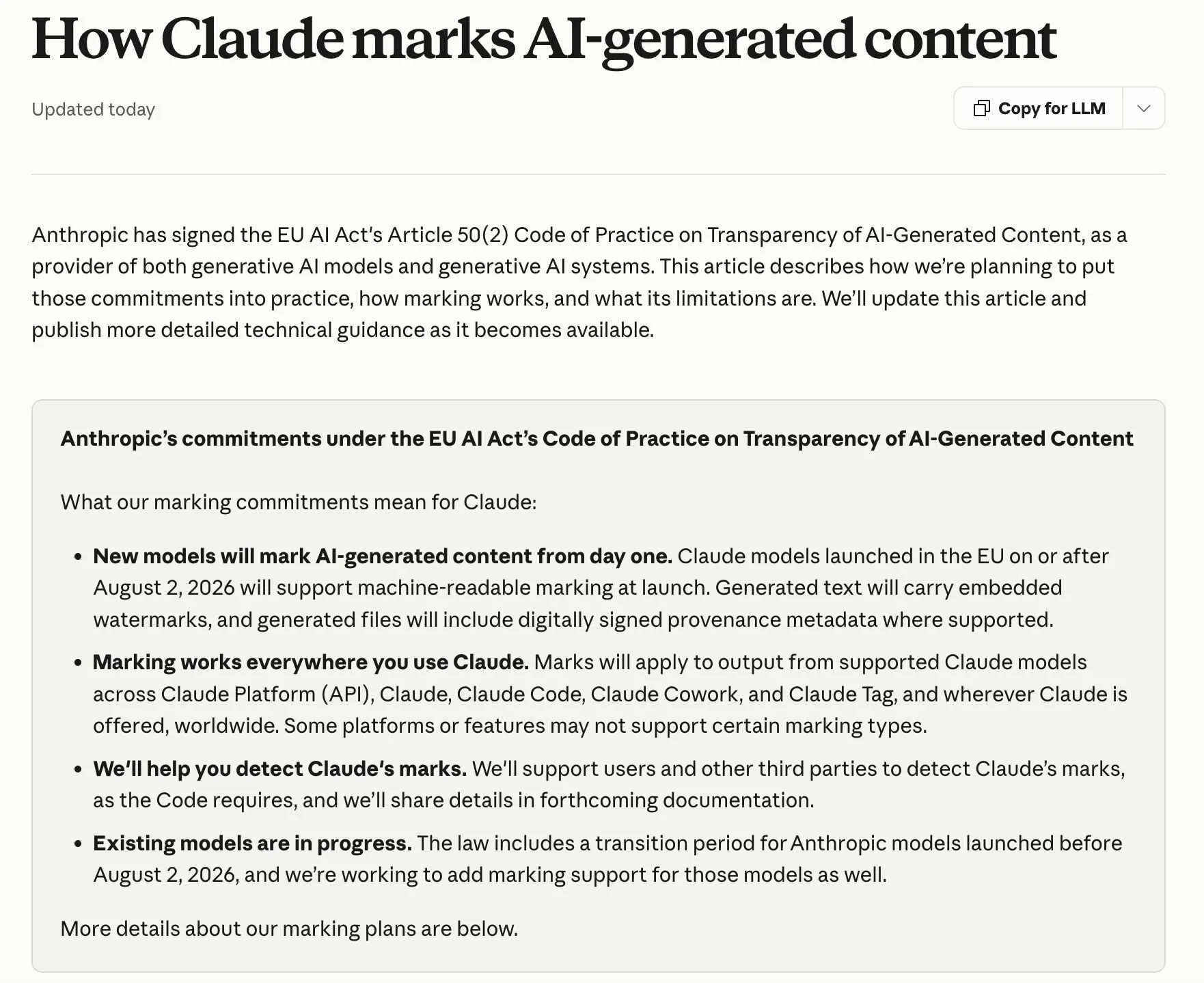
From Anthropic Help Centre
Surfer ran a smaller, more pointed experiment: identical topics, one version generated with Gemini, one with GPT, then tracked which got picked up. AI Overviews showed a consistent — if modest — preference for the Gemini-generated version across every position tested. Google's own model favouring content written by Google's own model is, as Surfer's own write-up admits, "at least worth a raised eyebrow."
None of this changes our view on production, which we've written about in the context of SEO content generally: the winning approach blends AI's speed on research and first drafts with a human editor's judgement, fact-checking and direct experience — the "Experience" in E-E-A-T that no model can fake on your behalf.
What the AEO data actually tells you is narrower and more useful: don't assume AI-assisted content is quietly being penalised in citations.
It isn't.
What's being penalised is genuinely generic content, produced by anyone or anything, that fails the first-paragraph test above.
YouTube is quietly the biggest AEO play most teams aren't making
If there's one finding in this research that should reorder a content team's priorities, it's this one.
According to Ahrefs, YouTube is now the most-cited domain in AI Overviews, and its citation volume has grown 34% in the past six months alone. Among AI Overview citations that don't rank anywhere in Google's top 100 organic results for the same query, 18.2% were YouTube URLs — meaning video content is winning citations through a side door that bypasses conventional ranking altogether. Separately, Ahrefs' study of 75,000 brands found that mentions on YouTube — in titles, descriptions, and transcripts — correlate more strongly with AI visibility than almost any other signal measured.
Pat Reinhart's framing from the Conductor webinar was blunter still: "YouTube is the number one cited site across all major LLMs." If your content calendar has no video component, close this gap first, not last.
If an AI cites Reddit for your topic, that's your opening
One of the more useful diagnostic signals to come out of the Conductor research: when an LLM cites Reddit as a source for a query in your category, it isn't a sign Reddit has better information than you.
It's a sign nobody has published a good enough answer yet.
As Conductor's Lindsay Boyajian Hagan put it, "LLMs only really cite Reddit when there's no other good source out there — so if you see Reddit, that's a good indicator that the LLM is craving content." Models don't refuse to answer. If nothing authoritative exists, they'll quote a forum thread rather than leave the question unanswered. Every Reddit citation you spot for a query that matters to you is effectively a content brief, handed to you for free.
Backlinks still matter. Just not for this
Traditional link building still matters for classic organic rankings, but its role in AI citation is smaller than most SEO teams assume. Pat Reinhart was direct about it in the Conductor session: "I don't think backlinks have much importance at all" for AI visibility specifically, adding that he hasn't built a link in about 20 years and has never struggled to rank a site. What he weighs instead is entity strength and factual density — whether a model can extract clean, verifiable claims from your page, not how many other sites point at it.
That doesn't make link building worthless. It makes it a lever for a different machine.
Freshness is a signal, not a stunt
AI Overviews are genuinely unstable at the surface level — Ahrefs found their content changes 70% of the time on repeated checks, and citations shift 46% of the time. However, the underlying meaning is far steadier than the surface suggests: consecutive overviews for the same query average a 0.95 cosine similarity. The wording moves around constantly; the substance barely does.
That has a direct implication for how content teams should handle updates. Conductor's advice, when asked whether refreshing a page should come with a new publish date: performance decides. If a page keeps earning citations, leave it alone. Don't quietly change the date to look fresher — models read actual content signals, not metadata theatre.
Freshness matters, but it has to be real.
How to actually track any of this
Google doesn't hand you AI Overview data on a plate. Clicks from AI Overviews blend into standard Google / organic traffic in GA4 and Search Console, with no built-in way to isolate them. A few workable approaches, in order of effort:
Watch for the "great decoupling." A page that holds its ranking and its impressions but sees click-through rate quietly fall is very often losing clicks to an on-SERP AI answer, not losing visibility. Ahrefs measured a 34.5% drop in position-one CTR following a major AI Overview rollout — rankings didn't move, clicks did.
Filter Search Console for AI-shaped queries. Informational, non-branded, question-led terms are the ones AI Overviews trigger against most — Ahrefs puts the figure at 99.2% of AIO-triggering keywords. Comparing CTR before and after a known rollout date on that segment gives a reasonable read on impact even without direct AIO data.
Use a dedicated AI visibility tool. Ahrefs' Brand Radar and Surfer's AI Tracker both monitor citations, mentions, and share of voice across ChatGPT, Perplexity, Gemini and AI Overviews directly, including which competitors are winning citations you aren't.
Build the checks into your drafting process, not just your reporting. Surfer's Content Editor now runs a dedicated AI Search Guidelines pass alongside its usual SEO checks, flagging missing facts and entities an AI model would need to trust and cite a page, with an option to insert them automatically. The point isn't the specific tool — it's that AI-citation checks belong in the drafting workflow itself, not bolted on as a post-publish audit three months later.
This is also where we'd point you back to something we've written about before: LLMs learn from user feedback as well as training data.
When we noticed Gemini pointing to the wrong URL for a client's own site, a thumbs-down and a correction fixed it within weeks. Monitoring isn't passive — a model that's wrong about your brand today can be corrected, and increasingly, agencies like ours are building that correction loop into ongoing client work rather than treating it as a one-off fix.
The playbook
Pulling all of the above into an order of operations:
Rank first. Nothing else here matters if you're outside the top three to five organic positions for the topic. Existing SEO investment is the entry ticket, not a sunk cost.
Confirm and answer in your first paragraph. State the topic in sentence one, give the short answer before the elaboration. It's the featured-snippet playbook applied to a new surface, not a new invention — and it accounts for most of the weight in Surfer's citation model.
Write for the intent behind the query, not the words in it. A comparison query wants a verdict. A cost query wants numbers. A how-to query wants steps. Match the actual reason someone typed the question.
Make your claims quotable. Specific numbers, named sources, concrete outcomes. If a sentence can't stand alone as a fact, it can't be cited as one.
Treat video as core infrastructure, not a nice-to-have. Given YouTube's outsized citation share, a topic without a video companion is leaving an entire citation channel unclaimed.
Scan for Reddit citations in your category. Each one is a market gap, with the content brief already written for you.
Update content when it's actually stale, not to look fresh. Models reward genuine freshness signals and ignore cosmetic ones.
Monitor and correct. Set up citation tracking, and when a model gets a fact about your brand wrong, fix it — don't assume it'll self-correct.
None of this replaces the fundamentals of good SEO content. It sits on top of them.
The Helpful Content principles Google has made a permanent ranking signal and the AEO factors above are pointing in the same direction: content that genuinely answers the question, quickly and specifically, wins in both systems at once.
The teams still writing padded, keyword-first copy for a results page that increasingly doesn't exist will feel this shift hardest.
Get in touch
We're already building AEO structuring and LLM visibility monitoring into clients' content programmes, alongside the SEO and content marketing work we've always done.
If your traffic is flatlining while your impressions climb — the exact pattern this whole piece is about — that's usually a sign the content is fine, and the structure isn't.
Get in touch, and we'll show you where your gaps actually are.
