
Content marketing for field service & home services SaaS

The trades software boom needs content that understands the trades
The field service management (FSM) software market is worth around $6.26 billion globally in 2026, and it's forecast to reach $9.87 billion by 2031. In the US alone, the market has already passed $3 billion and is growing at roughly 7.5% a year.
Barely a month goes by without another acquisition, another platform rebrand, or another well-funded challenger promising to modernise how HVAC, pest control, plumbing, electrical, roofing and landscaping businesses run their day-to-day operations.
Here's the problem: a lot of the content coming out of this space still reads like it was written for a generic B2B SaaS buyer who lives in Slack and worries about "digital transformation." The real buyer for field service software is often a business owner who started out with a van and a toolbox, or a regional operations lead juggling a dozen technicians, a dispatch board and a compliance deadline.
Generic SaaS copy doesn't land with either of them.
We've actually lived in this world
We're not theorising.
For two years, from May 2024 to May 2026, we ran the content programme for Aspire and FieldRoutes, two platforms in the ServiceTitan portfolio — Aspire in landscaping software, FieldRoutes in pest control software — producing 15–20 pieces a month between them. The teams were based in California and Colorado; we ran the account from Estonia, which meant genuine handover coverage against US working hours rather than a single writer working alone against a deadline.
This is what proper SEO content writing services look like in practice, not the version most people picture. Over 80% of companies now use content marketing, and roughly half outsource it — but "outsourcing content" for a technical, high-volume category like this one means something closer to running an in-house editorial team remotely than briefing a freelancer.
The output wasn't a blog churning out listicles. It was blog posts, SEO-led how-to content, landing pages, in-depth data and statistics pieces, and head-to-head comparison pages against named competitors — the full spread a platform at that stage actually needs, not a single content type stretched thin.
Two buyers, one register problem
FSM and home-services SaaS have an unusually split audience.
On one side, an owner-operator who wants to know, in plain language, whether this will save them admin hours and get them paid faster. On the other, an enterprise or franchise decision-maker who wants integrations, compliance credentials and proof it scales across dozens of locations.
Content that tries to speak to both at once, in the same jargon-heavy voice, tends to convince neither. We wrote deliberately in two registers across that programme: plain-spoken, practical guides for the SMB path, and more technical, data-led pieces for the buyers evaluating this at scale.
Search has already changed — and buyers are asking AI directly
More than half of all searches — 58%, based on what we heard first-hand at BrightonSEO San Diego, now end without a click-through to a website.
Traffic that does come from AI tools converts at around 8.7%, against roughly 0.8% for low-quality organic traffic. And comparison content — "X vs Y vs Z" pages — now earns roughly 12 times more citations in AI-generated answers than a standard blog post. For a category with a genuinely crowded field of named competitors, that single stat should change how you prioritise your content calendar.
This is the shift from ranking to being referenced. Traditional SEO was built on links; GEO is built on language — the newer discipline of shaping content so generative engines choose to cite it. And increasingly, buyers aren't searching at all; they're asking ChatGPT, Perplexity or Gemini directly which platform has the best route optimisation or the most reliable technician scheduling and taking the answer at face value.
Winning brand visibility inside those LLM responses is a different, more specific discipline than classic SEO — it rewards clear definitions, named entities and structured, extractable answers over keyword density. Software that publishes specific, well-structured content about compliance or scheduling has a real shot at being the source an AI cites back to that buyer.
Thin, keyword-stuffed listicles don't get that treatment.
What "content at scale" actually looks like
Fifteen to twenty pieces a month sounds like a lot until you see what a platform in this space genuinely needs. One recurring stream, for Aspire, was a state-by-state regulatory and licensing series — the exact permits, fees and steps to legally run a landscaping business in, say, Alabama or Utah — which only makes sense as a 50-state programme, not a one-off post. Alongside it, for FieldRoutes, ran operational best-practice guides (inventory management, technician scheduling, waste and compliance handling), customer success stories, and comparison pages against named competitors for buyers already shortlisting.
None of that works if it's padded to hit a word count rather than written to genuinely help. The average first-page Google result today runs about 1,447 words — not because longer automatically ranks better, but because a state licensing guide or an inventory-management guide that's actually useful tends to need the space. Google's Helpful Content system treats this as a permanent ranking signal now, not a passing update, which matters more in a compliance-heavy category than almost anywhere else.
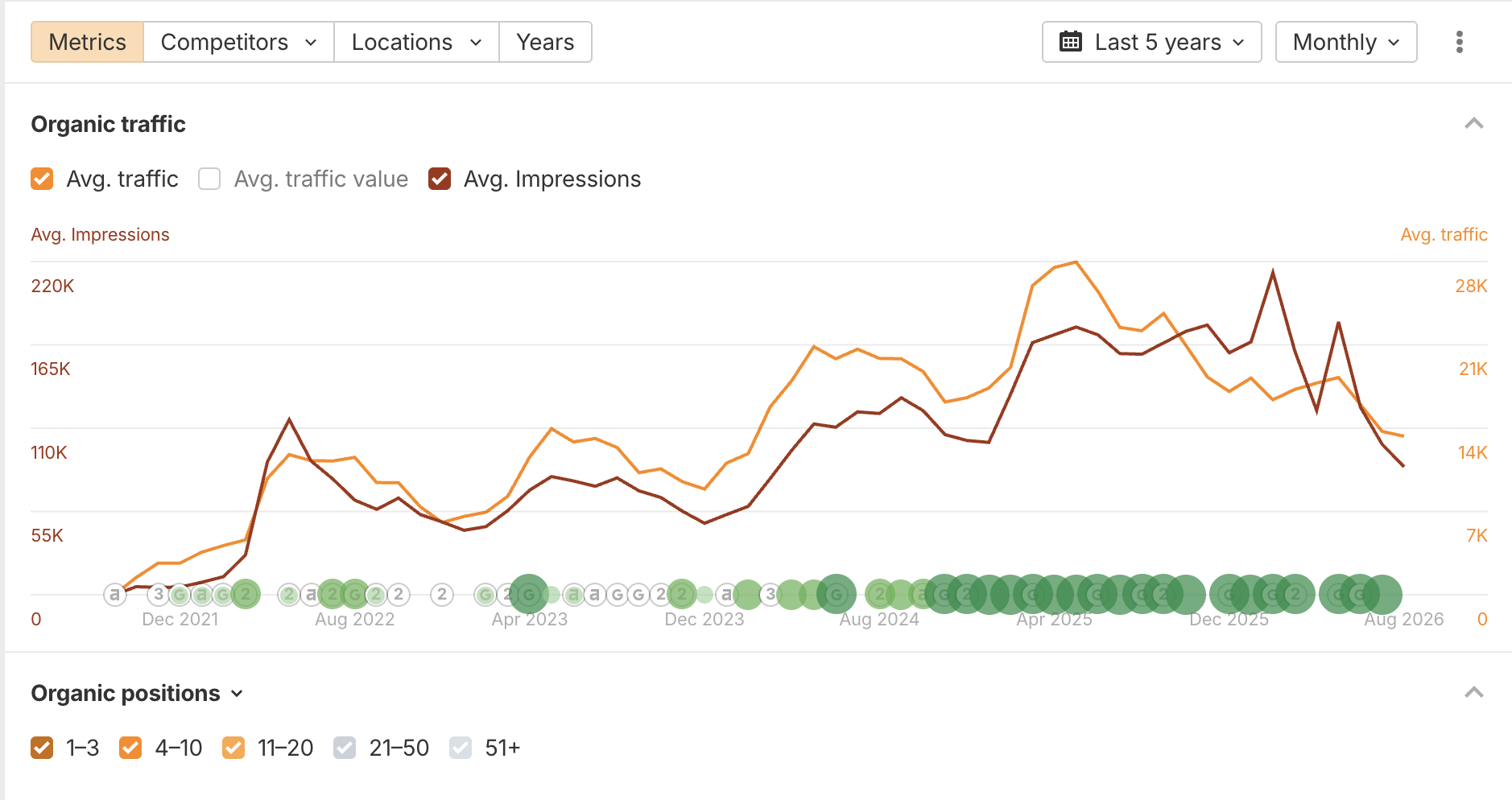
Aspire client metrics in Ahrefs
This is also where the acquisition-driven consolidation in this category bites. Every roll-up leaves overlapping blogs, orphaned legacy content and tangled SEO behind it — untangling that while still hitting a monthly output target is a technical migration problem as much as a creative one, and it's exactly the kind of work that separates a genuine content operation from a freelancer topping up a spreadsheet.
There's also a quieter reason volume matters in this category: a 50-state licensing series, a rolling set of best-practice guides, and a live comparison bench against named competitors only compound in value if someone keeps them current. Regulations change state by state, competitors ship new features, and a comparison page that was accurate in January can be wrong by June.
Fifteen to twenty pieces a month isn't really about the initial build — it's the maintenance cadence this fast-moving category actually needs.
Publishing isn't the same as being found
A blog on its own doesn't do much.
Businesses that blog consistently see roughly 13 times the ROI of those that don't — but that number assumes the content actually reaches people, which takes a deliberate mix of owned, earned and paid channels rather than a "publish and hope" approach.
We built a distribution plan alongside the content plan for both platforms: syndication and backlink outreach for earned reach, paid social for the comparison pages closest to a buying decision, and a genuinely structured internal linking strategy so the state-by-state series reinforced itself rather than competing against its own pages.
What the numbers actually showed
Both properties currently carry a Domain Rating in the high 50s to mid-60s, a combined 3,000-plus ranking organic keywords, and north of $170,000 in estimated monthly organic traffic value between them. More telling than the current snapshot is the shape of the growth: both sites show a sharp, sustained acceleration in organic impressions and traffic that lines up closely with when the content programme began, continuing through most of the two-year run.
In the few months since handover, both have cooled slightly. We'd rather be straight about that than pretend otherwise — it's a useful reminder that a content engine needs ongoing stewardship, not just a strong launch, and it's exactly the gap a sustained partnership is built to close.
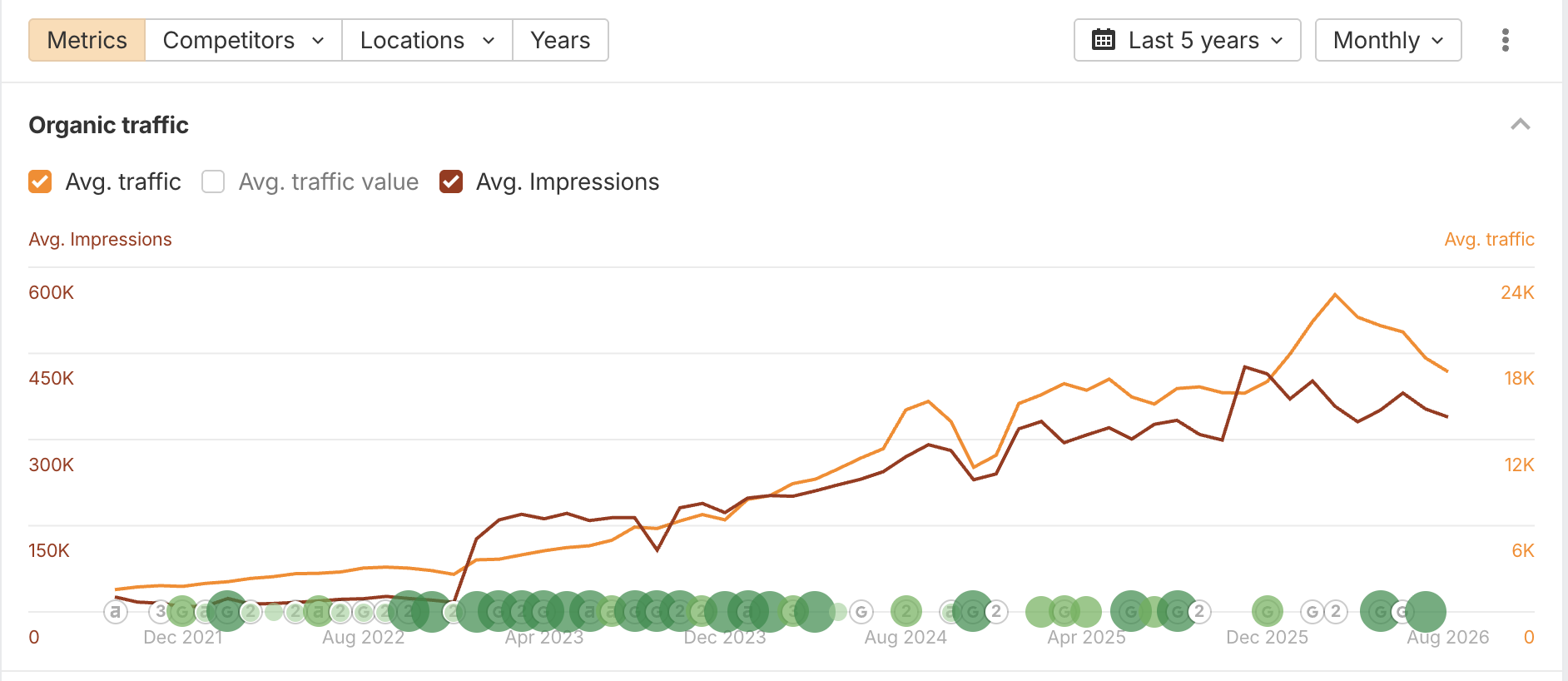
Fieldroutes client metrics in Ahrefs
It's also a reasonably clean illustration of the AI-visibility point above: a site that stops publishing doesn't just lose new rankings, it slowly stops being the fresh, well-maintained source that generative engines prefer to cite. Traffic softening isn't only a search-engine story any more — it's an AI-citation story too, and the two increasingly move together.
Get in touch
We built this programme from Tallinn for teams in California and Colorado, which meant genuinely covering US hours rather than working nine time zones behind and hoping for the best.
That's the standard we'd bring to any American field service, home-services, or trades software brand next: real coverage, real category fluency, and a content operation built to run at the pace this market actually needs.
If you're building content for a platform in this space — whether you're at a franchise-scale player or a fast-growing challenger — get in touch and let's talk about what your content operation actually needs.
-
In our experience running two platforms in this space for two years, 15 to 20 pieces a month across blog posts, SEO-led how-to content, landing pages, data pieces and comparison pages against named competitors. Fifteen to twenty pieces is really a maintenance cadence, not just an initial build, since regulations, features and competitor comparisons change constantly in this category.
-
Significantly. Comparison content, 'X vs Y vs Z' pages, earns roughly 12 times more citations in AI-generated answers than a standard blog post. For a category with a genuinely crowded field of named competitors, that is worth prioritising directly in a content calendar.
-
Both properties cooled slightly in the months following handover. We would rather be straight about that than pretend otherwise, it is a useful reminder that a content engine needs ongoing stewardship, not just a strong launch, and it is exactly the gap a sustained partnership is built to close.
-
Yes, this is an unusually split audience. An owner-operator wants plain language on whether a platform saves admin hours and gets them paid faster. An enterprise or franchise decision-maker wants integrations, compliance credentials and proof it scales across dozens of locations. Content written in one voice for both tends to convince neither.
