
Using a content distribution strategy to increase online engagement

Ever wondered how much content is on the internet?
Too much to count. Look at it this way: six new websites, 116 new blog posts, and 500 minutes of YouTube video are published on the web every second.
That's just the tip of the iceberg.
Given all the noise in the content marketing space, even high-quality content can get lost in the crowd. One way to mitigate that risk is through content distribution.
What is content distribution?
Content distribution is the process of disseminating content to your target audience through owned, earned, and paid media. Effective content distribution helps to increase brand awareness, generate leads and sales, and establish a strong online presence.
Success lies in achieving the right distribution mix for your content and audience.
Which media channels should you focus on to enhance your digital presence? Selecting the right online and offline marketing channels is a crucial part of a comprehensive content marketing strategy, as it ensures your content reaches and engages your target audience effectively. What types of content are ideal for distribution and on which channels? Understanding the difference between web copy and broader web content helps you choose the right formats and messages for each stage of your distribution strategy.
This guide covers all that and more. So let’s dive into content distribution.
TL;DR highlights:
In a content-saturated internet, effective content distribution is vital for boosting brand awareness, generating leads, and building a robust online presence.
The main content distribution channels include owned channels (controlled by the business), earned channels (external sharing and promotion), and paid channels (advertising and sponsorship).
Owned channels offer control but limited reach, earned channels provide wider reach but less control, and paid channels offer immediate results but require a budget.
Maximising owned channels, such as websites, blogs, and social media, involves creating mobile-friendly, SEO-optimised, and visually engaging content with clear calls to action.
Success in content distribution is measured by metrics such as website traffic, social media engagement, conversion rates, cost per acquisition, and attention metrics. Continuous tracking and optimisation of content is key.
Understanding content distribution channels
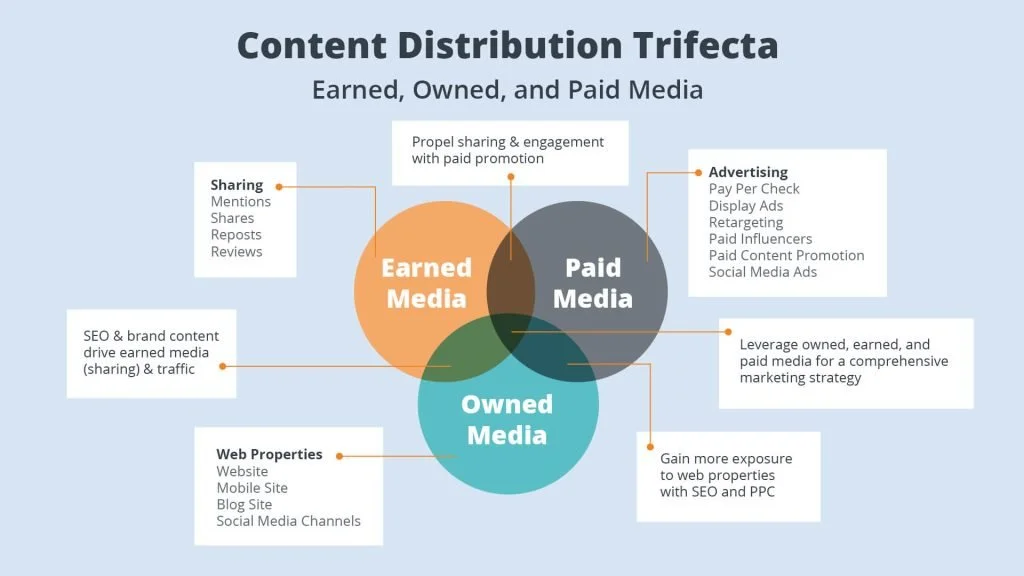
Content distribution involves disseminating digital content through three different media channels: owned, earned, and paid.
Each channel has unique characteristics and offers specific advantages and disadvantages for marketers.
To maximise reach and engagement, it's essential to leverage multiple content marketing channels and distribute content across them, adapting content formats for different platforms and audience segments.
Owned channels
Owned channels are online platforms and assets that businesses own or control (also known as owned distribution channels), such as websites, social media pages, and blogs.
With owned channels, businesses have complete control over content creation and distribution, so investing in SEO content writing and conversion-focused copywriting for these assets can significantly improve results. However, the reach of owned channels is limited to existing followers and subscribers. Examples of content types typically used for owned channels include blog posts, ebooks, and case studies.
Earned channels
Earned channels involve the sharing and promotion of content by external sources, such as social media users, backlinks, and media coverage. Unlike owned channels, businesses do not have complete control over distribution on earned channels.
However, earned channels offer the potential for increased reach, including viral, and can serve as validation of the content's quality and authority. The key content type for earned channels is shareable content that encourages engagement, such as videos, thought leadership, and testimonials.
Paid channels
Paid channels involve promoting content through paid advertising and sponsored content, including highly targeted pay-per-click campaigns. Paid channels deliver immediate, measurable results in terms of reach and engagement.
However, they require a dedicated budget and are best suited for short-term gains, rather than building exposure and reach for the long term. The key content type for paid channels is targeted, eye-catching content that drives clicks and conversions.
Influencer marketing is another effective paid channel in which businesses collaborate with industry influencers to amplify content and reach targeted audiences. Many brands also partner with a specialised digital media buying and advertising agency to manage multi-platform paid distribution at scale.
Content distribution channels: pros & cons
| Channel Type | Advantages | Disadvantages |
|---|---|---|
| Owned | Complete control over content creation and distribution | Reach is limited to existing followers and subscribers |
| Earned | Expanded reach and builds authority | No control over distribution and lower predictability of results |
| Paid | Immediate and measurable results in reach and engagement | Requires a budget and may generate less sustainable organic reach |
The type of content, budget, and target audience should all be considered when choosing the most suitable channel for promoting the content.
How does content distribution work?
Before jumping into the mechanics of content distribution, it is essential to understand the importance of a well-planned content strategy.
Developing a clear content strategy will help businesses identify their target audience, create content that speaks directly to them, and set distribution goals. Aligning this with a solid search engine optimisation strategy ensures that each piece of content is discoverable in search results and continues to perform well over the long term. A well-structured content creation process ensures that each piece of content is aligned with distribution and marketing objectives, making your overall strategy more effective.
Once the content strategy is in place, businesses can move on to promoting their content through owned, earned, and paid channels. Let’s take a look at how content is distributed via each channel:
Owned channels: Owned channels are the logical starting point for distributing content. You can create, distribute, and test a range of content at your own pace, focusing on your target audience and customers. Content can be published on the company website, blog, social media pages, or distributed via email to customer or prospect lists.
Earned channels: Earned channels are more challenging to acquire, as you will need to reach out to third-party entities and convince them to share your content on their platforms. Examples of earned channels include social media shares, backlinks, media coverage, and influencer collaborations. Earned media requires building relationships with external partners, which takes time and effort. However, earned media distribution is highly valuable, as it helps businesses reach a wider audience and boost their online presence and credibility.
Paid channels: These channels involve directly paying for content promotion or advertising, such as social media ads, sponsored content, Pay-Per-Click (PPC) ads, including dedicated Google Ads management and PPC services, or native ads, such as Outbrain. The “trick” to a successful paid content distribution strategy is careful planning, budgeting, tracking, and optimisation to avoid overspending and targeting the wrong audience.
Content syndication
In addition to the three channels mentioned above, businesses can also make use of content syndication to increase reach and visibility. Content syndication is a different form of earned media distribution, in which existing content is republished on third-party websites or platforms.
This can be a good strategy for reaching new audiences and improving search engine rankings.
Content distribution types
When it comes to content distribution, diversifying content formats is key.
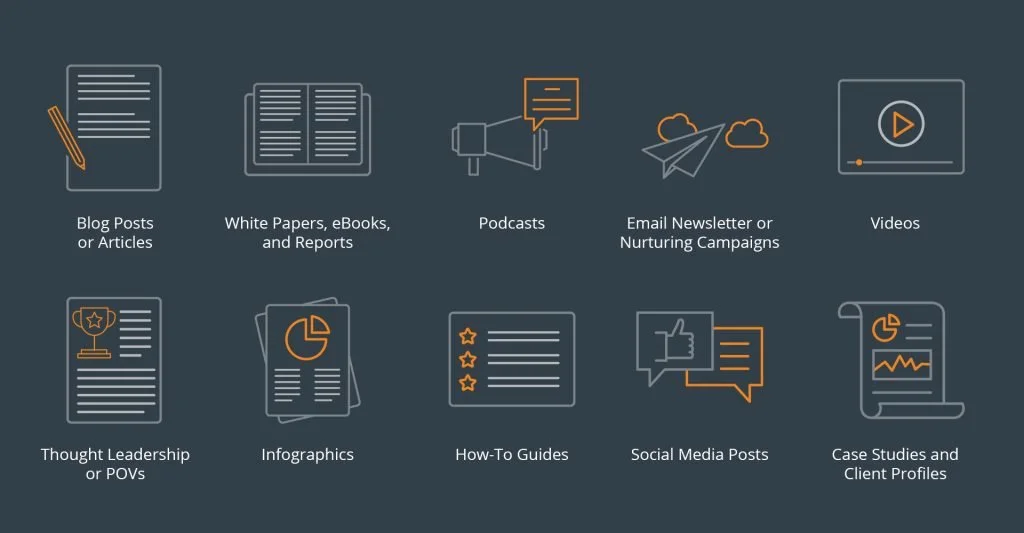
Businesses can distribute content in multiple formats, such as articles, videos, and infographics, across various channels to reach different audience segments, and on platforms like Facebook, which supports strategies to improve organic reach without relying on ads. Businesses can distribute a range of content types, from articles to videos, and interactive content, such as polls or quizzes. Common types of content include:
Each type of content has unique advantages and can help to engage different audiences.
For instance, visual content such as infographics and videos may be more effective at grabbing the attention of social media users, whereas thought leadership articles and case studies are ideal for B2B audiences.
Owned channels: maximising online assets
Owned content channels can provide businesses with a powerful means to reach their target audience.
Optimising owned channels is a crucial part of successful content marketing, ensuring content effectively engages the intended audience and supports business goals. By optimising content for online distribution, companies can greatly increase their reach and engagement by effectively using the owned channels at their disposal.
But what are the best strategies for leveraging these channels?
Owned channels for online distribution
Websites: Business websites serve as the primary point of contact between the business and its online audience, making them a highly effective owned channel for disseminating content. By regularly posting case studies, landing pages, and other content on their website and by optimising webpage structure for SEO and conversions, businesses can increase traffic and engagement.
Blogs: Related to websites, blogs provide businesses with an easy-to-update platform for publishing content and creating discussions with their audience. This allows businesses to build rapport with their audience and provide valuable insights into their niche.
Social media platforms: Social media profiles on Facebook, X, LinkedIn, Instagram, and TikTok offer a powerful means for businesses to engage with their audience, share content, and increase brand awareness, especially when supported by professional social media management services, and can be further amplified through paid social media advertising services.
Optimising content for online distribution on owned media channels
Creating high-quality content alone is not enough to effectively engage an audience. Businesses must also optimise their content for distribution by:
Ensuring content is mobile-friendly and responsive
Creating eye-catching and attention-grabbing headlines
Using keywords and phrases to improve SEO ranking and visibility
Optimising images and videos for faster loading times
Encouraging social media sharing and commenting
Earned channels for content distribution: increasing exposure
In the world of content distribution, earned channels can be powerful tools for businesses looking to generate organic reach and increase engagement. Earned channels include social media shares, backlinks from other websites, and media coverage, among others. With the right techniques, businesses can leverage these channels to encourage content sharing and ultimately grow their digital presence.
Earned media requires effort and outreach, but can significantly expand your digital presence and exposure. By increasing brand visibility and credibility through earned channels, you can attract potential customers who discover your business via trusted third-party sources.
Encouraging content sharing
One effective way to encourage content sharing is to create high-quality, shareable, engaging content. This can include blog posts, videos, infographics, or other forms of content that provide real value to the target audience. Additionally, businesses can incentivise content sharing by offering exclusive discounts or other rewards for those who share the content on social media or other channels.
Building backlinks
Backlinks from other reputable websites can also help to increase organic reach and drive traffic to a business's website. One way to build backlinks is to create guest posts or other content for websites in the same industry.
This not only generates backlinks but also helps to establish the business as a thought leader in the industry.
Maximising media coverage
Media coverage can be a highly effective earned channel for content distribution. By building strong relationships with journalists and media outlets, businesses can increase their chances of being featured in news articles and other publications. This can help to increase brand recognition and drive traffic to the business's website.
Popular content types for earned channel distribution
Blog posts: Long-form or short-form written content that provides value and engages the target audience.
Videos: Visual content that can provide information or entertainment to the target audience.
Infographics: Visual content that presents complex information in an easy-to-understand format.
Guest posts: Written content published on other websites in the industry to build backlinks and establish thought leadership.
Media coverage: Press releases, news articles, and other forms of media coverage that can help to boost brand recognition.
Your website and social media platforms will not be enough to reach the broadest potential audience. That's why earned channels are a critical component of content distribution. Earned media requires effort and outreach, but can significantly expand your digital presence and exposure.
Paid channels: Pay to get content viewed more
Beyond owned and earned channels, paid content distribution can effectively amplify your reach and drive more traffic to your website in a relatively short time frame. Through targeted social media advertising, native advertising, and sponsored content, your business can ‘pay’ to target high-potential audiences, gain more exposure, and generate leads. Paid channels are particularly effective for lead generation by driving targeted traffic to landing pages and gated content such as e-books and whitepapers, which help capture potential customer information and nurture leads within your marketing funnel.
Social media advertising
Social media platforms like Facebook, X, TikTok, and LinkedIn offer powerful advertising options that allow businesses to target specific audiences based on demographics and interests. When creating your ad campaigns, it's important to use eye-catching visuals, persuasive copy, and targeted CTAs to drive conversions.
| Paid Social Media Network | Best Use |
|---|---|
| Facebook Ads | Targeting a wide range of demographics across B2C and selected B2B audiences |
| X Ads | Targeting tech-savvy and real-time engaged audiences |
| LinkedIn Ads | Targeting B2B professionals, decision-makers, and industry leaders |
| TikTok Ads | Targeting younger demographics through short-form, high-engagement content |
Native advertising
Native ads blend in naturally with the platform on which they appear, so they tend to perform better than display ads.
Rather than looking like traditional ads, native ads align more comfortably with the user experience and the platform's tone, making them less disruptive. Native ads can be especially effective for promoting blog posts, whitepapers, and other content types because the wide range of targeting options lets you deliver the right content to the right audience segment.
This is crucial to attracting attention and building audience engagement.
Sponsored content
Sponsored content involves paying to place your content on third-party websites or on owned media. This can include sponsored blog posts, sponsored content sections, and other cross-promotion opportunities. Sponsored content can drive referral traffic, generate leads, and position your brand as a thought leader.
When using paid channels, it's important to determine your budget, set realistic goals, and track your results. This will allow you to optimise your campaigns, continue with what works, and adjust your strategy as necessary.
As you test various channels and tactics, you'll discover what works best for your business and your target audience.
Measuring content distribution success
Investing time and money in distributing content across various channels is worthwhile, but it’s essential to measure success to continually refine distribution strategies. Here are some key metrics to track:
Website traffic: Monitor web analytics to measure the impact of published content on website traffic. Tracking visibility and rankings in search engine results pages (SERPs) is also crucial, as it helps assess how well your content is performing in both paid and organic search, and guides ongoing optimisation efforts.
Engagement metrics: Track likes, shares, and comments on published content. Reviewing these metrics helps to assess the content’s effectiveness and adjust distribution strategies accordingly.
Conversion Rate (CVR): Conversion rate measures the percentage of visitors who take desired actions on your website, such as subscribing to email lists, making a purchase, or downloading resources. Track conversion rate to determine if published content influences people’s actions.
Cost Per Acquisition (CPA): CPA indicates how much a conversion costs. It’s calculated by dividing total marketing costs by the number of conversions. By reviewing this metric, businesses can determine the success of paid distribution channels and adjust strategies accordingly.
Attention metrics: Measuring attention goes beyond simple viewability. New advances in adtech enable you to monitor how much actual attention your ad or content is receiving from real users. Attention metrics is a growing field, so keep an eye out for opportunities to track attention on the platforms you use for content distribution.
5 tips for successful content distribution
A key component of successful content distribution is creating high-quality content from the outset. There is no point in distributing content that is boring, unoriginal, or doesn't offer unique value to the audience.
Good content will be more attractive to third-party platforms and publishers, and will naturally attract more earned media exposure.
Here are the top 5 tips to improve the ROI of your content distribution investment:
1. Optimise for SEO
Optimise your content for search engines by incorporating relevant keywords, meta descriptions, and titles. This will ensure that your content is easily discoverable online, increasing its reach and visibility. A good SEO strategy is to focus on long-tail keywords. Long-tail keywords are more specific and less competitive, providing solid opportunities to improve your SEO rankings.
2. Collaborate with influencers
Partner with social media influencers and thought leaders in your industry to expand your reach and tap into new audiences. Influencers can share your content with their followers, increasing your brand's exposure and credibility.
3. Leverage user-generated content
The most trusted content online is not “expert” opinions, brand-produced content, or influencer content, but rather user-generated content. With so much information at their fingertips, many prefer content that is created by people just like them. UGC is seen as more “authentic” and is therefore more likely to engage readers. This is definitely a strategy you should incorporate in your content distribution efforts. Encourage customers to create and share their own content, such as product reviews or testimonials.
4. Experiment with different content types
The best approach to content distribution is to create a variety of content for different channels.
Diversify!
Keep your audience engaged and attract new followers with content such as blog posts, videos, podcasts, infographics, e-books, thought-leadership articles, case studies, white papers, social media posts, and more.
5. Consistently monitor and analyse performance
Checking content performance manually is only going to get you so far.
Use tools such as Google Analytics, Hotjar, Crazy Egg, Moz, Ahrefs, Buffer, and Sprout Social for social media analytics.
These provide businesses with a clear understanding of the overall effectiveness of their content distribution strategy. Implement changes proactively by regularly analysing your content performance metrics.
-
Content distribution refers to the process of disseminating digital content to maximise its reach, engagement, and visibility. It involves promoting and sharing content across various channels, including owned websites, social media platforms, and third-party syndication networks.
-
Content distribution is essential for businesses because it helps them increase their online presence, attract and engage a larger audience, and drive traffic to their digital assets. Effective content distribution can also help businesses establish thought leadership, generate leads, and boost brand awareness.
-
The key strategies for effective content distribution include:
developing a comprehensive content strategy
promoting content through various channels
leveraging content syndication networks
optimising content for search engines
and measuring the success of distribution efforts through data analysis.
-
Owned channels refer to platforms and properties that businesses control, such as websites, blogs, and social media accounts. Earned channels are organic channels where others share or amplify your content, such as social media shares and backlinks. Paid channels involve paid promotion and advertising, such as native ads, sponsored content, and social media ads.
-
Popular types of content for distribution include blog posts, white papers, testimonials, e-books, videos, podcasts, thought leadership articles, infographics, guides, and case studies. Diversifying content formats helps cater to different audience preferences and maximise engagement.
-
Businesses can optimise their owned channels for content distribution by implementing SEO best practices, creating engaging and shareable content, utilising relevant social media platforms, and regularly updating their websites and blogs with fresh content. It's also essential to include clear calls to action (CTAs) and user-friendly navigation.
-
Businesses can encourage content sharing and organic reach by creating high-quality, shareable content, incorporating social sharing buttons on their websites and blogs, engaging with their audience on social media, collaborating with influencers and industry experts, and offering incentives or rewards for sharing content.
-
Yes, paid channels can be effective for content distribution. Paid promotion on social media platforms, sponsored content on websites and blogs, and targeted PPC advertising can help businesses reach a broader audience and generate quick visibility and engagement. However, it's crucial to implement effective targeting and optimisation strategies to maximise ROI.
-
Businesses can measure the success of content distribution efforts by tracking key metrics such as website traffic, time spent on page, bounce rate, social media engagement, backlinks, and conversions. Various analytics tools, including Google Analytics and social media insights, can provide valuable data for analysing performance and optimising future distribution strategies.
-
Some tips for enhancing digital presence through content distribution include:
Optimising content for search engines
Leveraging influencer collaborations
Repurposing existing content into different formats
Utilising user-generated content
Engaging with the audience through comments and social media
Staying updated with current content marketing trends and best practices
