
ChatGPT built its own search index: why Bing visibility isn't a ChatGPT strategy anymore
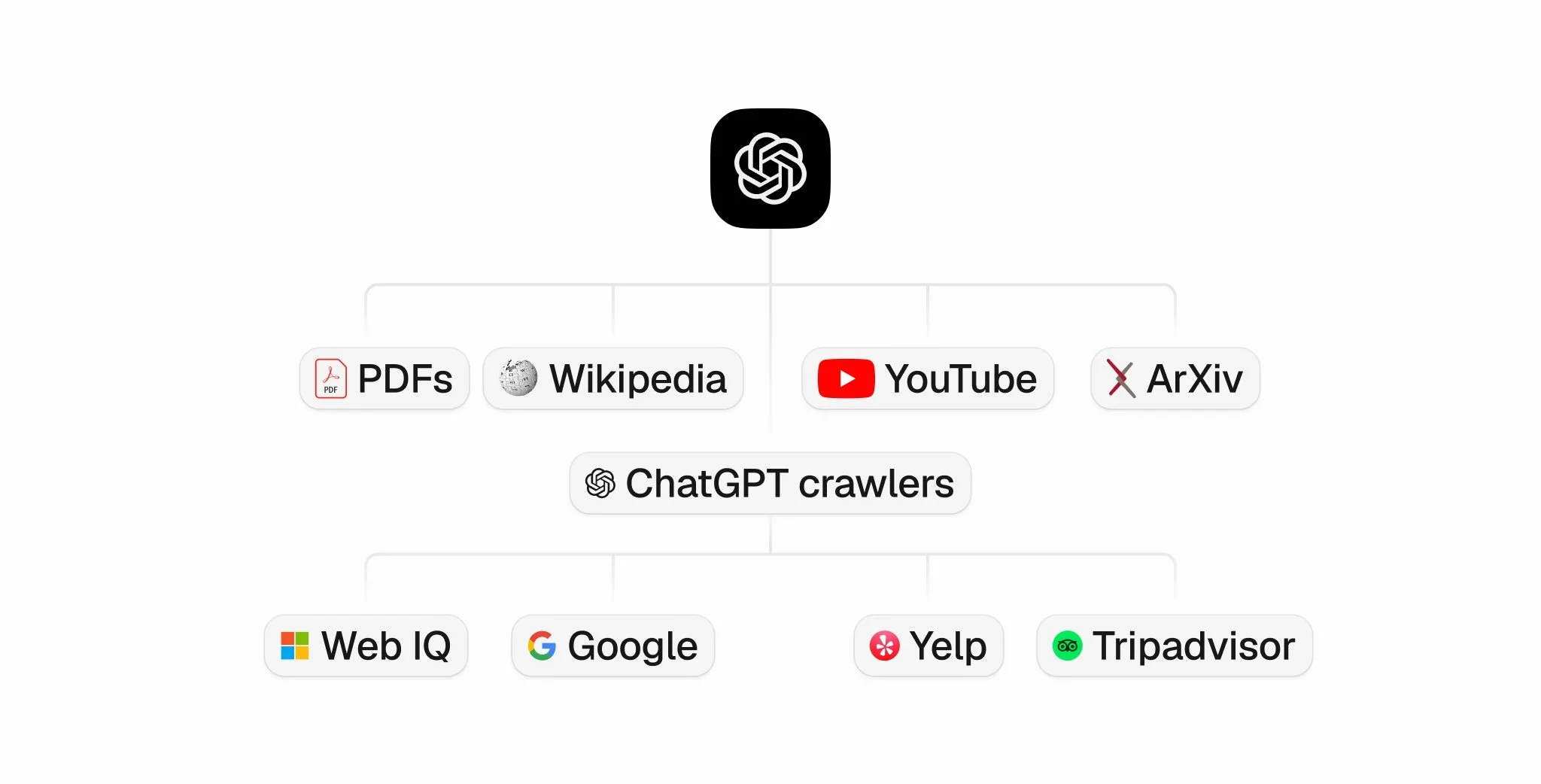
Source: PECC.AI
For two years, the working assumption across SEO and AEO circles was simple: ChatGPT retrieves through Bing and Google and doesn't run its own index. New investigative research from Peec AI shows that assumption is wrong, and the evidence behind it is genuinely hard to argue with.
The evidence, not speculation
This isn't a theory built on guesswork. Nick Turley, ChatGPT's head of product, testified under oath during Google's antitrust trial that OpenAI began building its own search index in 2023, initially targeting 80% of queries to be answered by it by the end of that year, a genuinely aggressive goal. Turley also confirmed OpenAI had approached Google about a data partnership and been turned down, forcing the in-house build as the fallback plan.
Separately, OpenAI's own job postings corroborate the same story.
Peec AI's research points to listings for roles explicitly built around indexing systems, retrieval pipelines, and infrastructure running at exabyte scale, a 1 followed by 18 zeros. That's not the kind of team a company builds to simply pass queries through someone else's index.
Peec AI's engineers also found direct, live evidence in ChatGPT's own server-side event data, a field literally naming which retrieval source powered a given response. Over a two-month window, that field carried exactly four values: three external scraping providers and one internal system called Labrador, OpenAI's own index.
Labrador isn't one index; it's a family of them
The genuinely useful detail here, for anyone thinking about content strategy specifically, is that Labrador isn't a single general-purpose index the way Google's original web index was. Peec AI's research identified separate, vertical-specific indexes covering the following categories.
| Index Vertical | What It Covers |
|---|---|
| General web | Standard web pages, the broadest category |
| Documents, reports, whitepapers | |
| YouTube | Video content specifically |
| News | Split further by recency, last day, last 7 days, and older |
| arXiv | Academic and research papers |
| Wikipedia | Reference and encyclopaedic content |
| Local | Business listings and location-based results |
| Finance | Financial content, with a separate sub-index for financial PDFs |
| Legal | Legal content specifically |
| Medical | Health and medical content |
| Shopping | Product listings and ecommerce content |
| Images | Visual content |
That structure matters practically.
A product page, a legal explainer, and a local business listing aren't competing in the same retrieval pool inside ChatGPT; they're being sorted, ranked and served through genuinely different systems.
Generic advice to 'write good AEO content' misses this entirely; the right technical approach actually depends on which vertical a piece of content falls into.
Shopping is where this is most visible right now, and the technical detail behind it is worth knowing.
Peec AI's researchers spotted a live A/B test, internally named 'prefer-index-over-serp-v3', running against a real slice of ChatGPT's shopping traffic. Behind it sits a genuine ranking pipeline: a lexical matching step that narrows results down to ten sources, a reranking stage that works across a pool of 400 product candidates, and a vector search component run at two different embedding dimensions.
As of early September 2026, Peec AI identified at least five separate live shopping experiments running simultaneously, direct, current evidence that OpenAI is actively testing its own index against scraped results in production, not just building it quietly in the background.
A separate experiment run by one of Peec AI's own researchers adds further weight to this.
A test website built specifically to measure ChatGPT's crawling behaviour, containing one billion pages, had already been crawled to the tune of six million pages within days, at a sustained rate of roughly 35,000 requests per hour. Crawling that aggressively only makes sense if the content is actually being stored somewhere for later use, not simply fetched and discarded, further evidence that a genuine, actively growing index sits behind the activity.
ChatGPT also caches pages, and you can check whether yours are current
Live retrieval on every single query would be too slow at ChatGPT's scale, so Peec AI's research points to a caching layer sitting alongside the index itself, with frequently retrieved pages kept ready rather than fetched fresh every time.
There's a genuinely useful, practical diagnostic that follows directly from this: ChatGPT's lockdown mode, which restricts the model to cached and offline results only, effectively lets anyone check whether their most important pages are actually cached and current or stale and out of date.
Google and Microsoft still matter, just not exclusively
None of this means Bing and Google visibility stop mattering. Peec AI's own testing found real, direct evidence that ChatGPT still queries Google when grounding certain answers, and Microsoft's own Web IQ platform confirms directly that it already powers ChatGPT retrieval alongside Copilot. Bing shows up too, particularly in Deep Research sessions.
The real picture, based on this research, is that ChatGPT now stitches together at least eight separate providers into one blended retrieval system.
Its own crawler, running independently of any external search engine
A provider very likely to be Bright Data, scraping Google's web results and, separately, Google Maps for local listings
Oxylabs, scraping Google and feeding the news vertical specifically
A third, separately tagged scraping channel serving news and a mixed local-results version
Yelp, treated as a licensed partner for local and review content
TripAdvisor, similarly licensed
Two internal, unnamed pipelines, one surfacing business websites and Facebook pages, the other routing to Google Maps
Microsoft's Web IQ, confirmed directly by Microsoft as already powering ChatGPT retrieval alongside Copilot and enterprise clients
Being visible in any single one of those, Bing included, is no longer a reliable proxy for being visible in ChatGPT as a whole.
What this actually changes for strategy
A few practical shifts follow directly from this research, building on what we've already covered in AI citation tracking and what actually gets a page cited by AI Overviews.
Stop treating Bing visibility as a proxy for ChatGPT visibility; the overlap is genuinely smaller than most SEO advice currently assumes
If you sell products, shopping is where OpenAI's own index is being tested most actively right now, worth specific attention
If local listings matter for your business, Yelp and TripAdvisor function as licensed partners inside this system, worth getting right directly rather than assuming Google Maps data covers it
Check your own pages in lockdown mode to see whether ChatGPT's cache actually reflects your current content
This also directly refines a point covered in SEO and brand visibility in LLMs, which distinguishes static LLMs from search-augmented ones. ChatGPT isn't simply search-augmented via Bing; it's running a genuinely layered system of its own index plus multiple external providers, closer in complexity to Google's own architecture than a simple pass-through. The same shift matters for paid ChatGPT visibility specifically and for the broader GEO discipline, since organic retrieval mechanics and paid placement both sit on top of the same underlying index structure.
Why this is exactly the kind of thing worth watching continuously
Worth being honest about something: Peec AI says plainly about their own findings that this system is being rebuilt week to week, and some of what's documented may already look different by the time it's read.
That's not a caveat to gloss over; it's the actual argument for why this needs ongoing attention rather than a one-time audit. The index structure, the live A/B tests, the provider mix, all of it shifts continuously, which means genuine AI search visibility work looks like continuous monitoring, not a checklist completed once and filed away.
That's also, honestly, why a piece like this matters beyond just the information in it.
Citing primary sources, real antitrust testimony, real job postings, a week-old investigation, rather than repeating a year-old AEO playbook, is itself the actual evidence of staying current in a field that moves this fast.
If you want your content strategy built around what's actually true about AI search retrieval right now, not what was true a year ago, get in touch to talk through what that looks like for your business.
-
Not quite, Bing still matters, particularly for ChatGPT's Deep Research feature specifically. What's changed is that Bing visibility alone is no longer a reliable proxy for overall ChatGPT visibility, since ChatGPT now blends at least eight different retrieval sources together.
-
Labrador is OpenAI's own internal name for ChatGPT's family of search indexes, confirmed through live server-side event data and corroborated by OpenAI's own job postings and antitrust testimony. It isn't one index, it's separate ones for web content, shopping, local listings, finance, legal, medical content, news and more.
-
ChatGPT's lockdown mode restricts responses to cached and offline data only, effectively letting you see what ChatGPT already has stored for your site without it fetching a live version, a genuine, practical way to check whether your most important pages are current in its cache.
-
Related, however not identical. The underlying principles, structure, clarity, genuine authority, still matter, however the specific mechanics differ by vertical inside ChatGPT's indexing system, and the retrieval mix itself changes frequently enough that this needs ongoing attention rather than a one-time optimisation pass.
