
Gulf enterprise marketing, why Arabic-language content is the real differentiator

A recent enterprise IT services engagement in the Gulf uncovered something worth noting beyond its own industry.
Analysing a $4.6 billion target market, the consultants found a complete competitive white space, zero alternative providers combining regional physical presence with native Arabic-language capability.
That's not a marketing platitude about "the importance of localisation"; it's a quantified, real finding, a genuine gap that language capability alone was enough to create.
The ambition is real, and it's government-funded
Gulf governments aren't treating digital transformation as an aspiration; they're funding it directly.
The UAE's National AI Strategy 2031 and Saudi Arabia's roughly $20 billion AI investment roadmap under Vision 2030 have laid genuine institutional groundwork, backed by sovereign-scale infrastructure investment, Google Cloud and Aramco co-investing over $10 billion in Saudi data centres and AI clusters, Microsoft Azure operating multiple cloud regions across Dubai and Abu Dhabi.
Corporate adoption is following closely behind.
Corporate AI adoption across the GCC sits at 84%, nearly matching the 88% global average, genuinely close to parity with markets that get treated as more digitally mature by default. The gap that actually matters sits further along, only 31% of companies have scaled AI past a single department or use case, a real maturity gap between pilot and genuine operational integration.
The legacy challenges are specific, not generic
B2B marketing in the Gulf has historically run on relationship-building and in-person connection, particularly in high-value sectors like real estate, construction, energy and finance. That approach built real trust, but it doesn't scale, and a specific, well-documented set of structural problems has followed from it:
Long, opaque sales cycles, with multiple stakeholders and decision layers making deal velocity genuinely hard to forecast
Fragmented data systems, disconnected CRMs, ERPs and marketing tools that make a unified customer view difficult to build
A real talent shortage, fewer than 12,000 certified AI professionals operate across the entire GCC region, a genuine constraint on how fast companies can actually execute on digital ambition
Genuine linguistic diversity, Arabic, English, French, Urdu and Farsi are all in active business use across the region, and most outreach fails to localise properly for different audience segments
That last point is the one most marketing advice glosses over fastest, and it's exactly where the consulting finding above becomes directly relevant.
Where adoption is actually concentrated
AI-driven marketing adoption in the Gulf isn't spread evenly, it's concentrated in specific sectors with specific reasons for moving first. Real estate and smart city developments lean on behavioural analytics and multilingual conversational tools, some Gulf developers have reduced lead drop-off by 30-50% using Arabic, English and other regional-language chatbots on property sites.
Finance and fintech, among the region's earliest and most advanced adopters, use AI for dynamic pricing, predictive risk models and automated compliance-checked content, driven as much by regulatory pressure as competitive appetite. Firms that genuinely embed AI into sales and marketing pipelines report a 15-30% improvement in customer acquisition efficiency, a real, measurable gain rather than a vague transformation claim.
Defence and resilience is a third sector worth naming specifically, and one where marketing operates under genuinely different rules to consumer-facing industries.
The GCC defence market itself is real and growing fast, at $41.85 billion in 2025 and projected to reach $54.72 billion by 2030. What's driving that growth isn't abstract either, regional analysts have described this year's conflict involving Iran as something close to the GCC's own Ukraine moment, a genuine, current shift toward indigenous defence capability and business continuity planning, not just external security guarantees. Industry reporting confirms the shift: organisations across the Gulf are actively moving from reactive security models toward continuous, adaptive resilience systems, embedded into national infrastructure planning rather than bolted on afterwards.
This is a sector where the Arabic-capability and discretion arguments made throughout this piece apply with even more force: real relationships and real regional trust matter more here than almost anywhere else, and it's an area we understand directly through our own sister company Fortivus.
The pattern across sectors is consistent: adoption moves fastest where the language and compliance stakes are highest, which is exactly where generic, English-first marketing tends to underperform most visibly.
What the white space actually proves
The enterprise IT services analysis didn't just note that Arabic capability would help; it found a $470 million addressable opportunity in the gap left by providers with scale but no language capability, or language capability but no real regional presence.
Real regulatory drivers were accelerating the opportunity too, government e-invoicing mandates, new data sovereignty laws, and a major vendor eliminating enterprise volume discounts, forcing measurable cost increases and genuine buyer dissatisfaction.
The UAE and Saudi Arabia together represented roughly three-quarters of the total opportunity identified.
The broader point holds well beyond that specific engagement. A provider with genuine regional presence and genuine Arabic-language capability isn't offering a nice-to-have translation layer; it's occupying territory most competitors simply haven't bothered to enter properly.
The regulatory landscape is moving too, not just the technology
Content and campaigns built for the Gulf can't assume a static regulatory backdrop either.
Bahrain is drafting one of the world's first national AI laws, covering model training, data bias and sectoral accountability. Saudi Arabia's Data and AI Authority released formal Generative AI Guidelines governing responsible development and deployment across public and private sectors.
The UAE, while still business-friendly by regional comparison, is actively developing sector-specific AI standards for finance, education and healthcare.
None of this is settled, and marketing content that doesn't account for a shifting compliance backdrop risks looking naive to buyers who are watching these developments closely, particularly in regulated sectors like finance and government procurement.
What genuine Arabic-language capability actually looks like
Worth showing rather than just asserting this. Blu Mint built the full Arabic-language site for Fortivus, our sister company operating in defence and resilience, a genuine native RTL build, not a translated English page with a language switcher attached. Full navigation, legal pages, and complete sector coverage, all in Arabic, as part of a broader multilingual operation spanning 24 full native-language sites in total, each built properly rather than machine-translated as an afterthought.
| Language | Gulf Market Relevance |
|---|---|
| Arabic | GCC enterprise and government buyers directly |
| Turkish | Turkey's regional business ties to Gulf markets |
| English | Baseline for international and cross-border buyers |
| 21 further languages | Genuine multilingual capability well beyond a single-market translation layer |
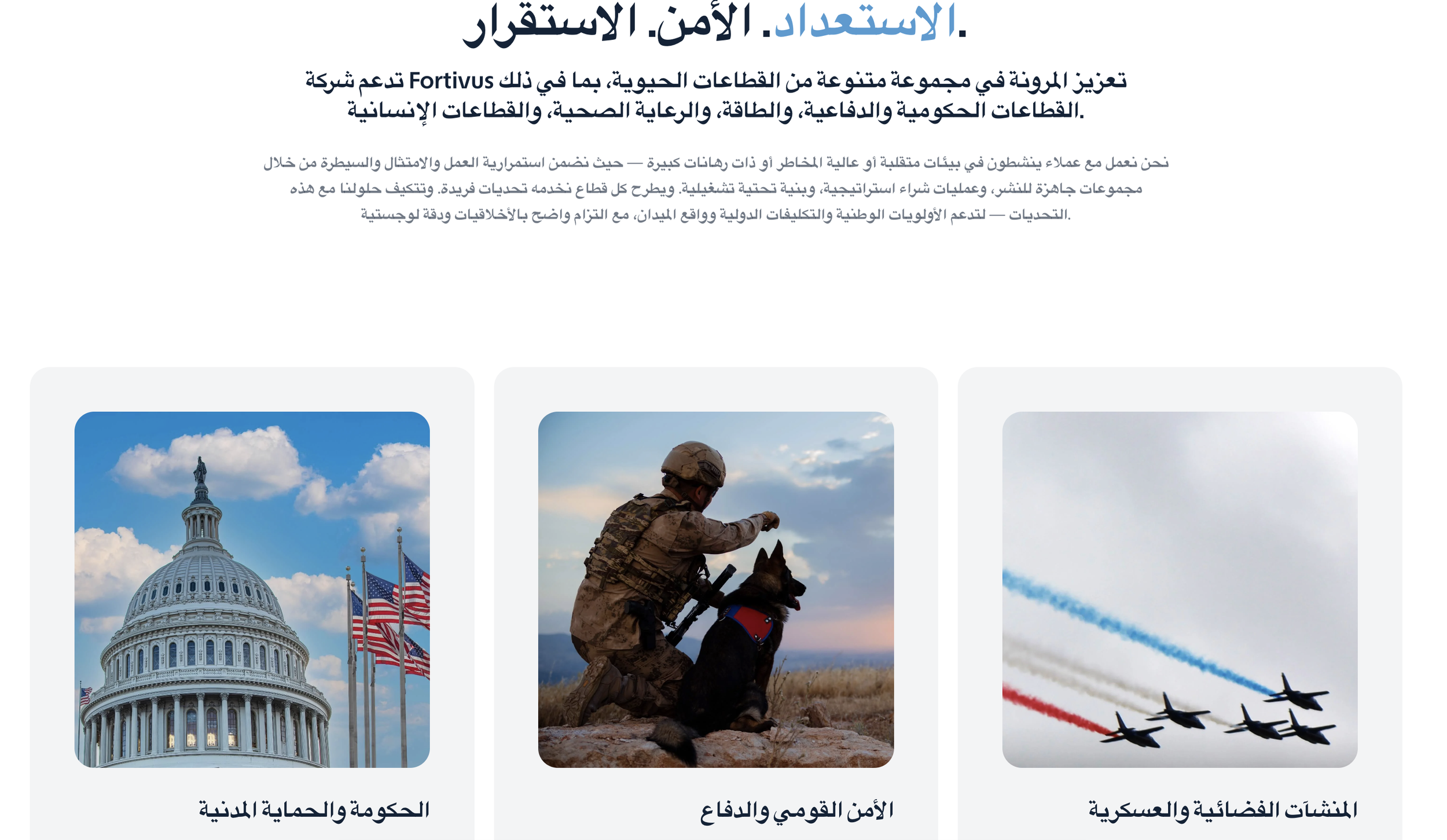
Fortivus in Arabic
What this means practically for Gulf enterprise marketing
A few things follow directly from all of this.
Content built only in English, then translated once budget allows, misses exactly the gap the consulting analysis quantified.
Genuine Arabic-language content, built natively rather than translated after the fact, isn't a cost centre; it's occupying the same kind of competitive white space a $470 million market analysis found sitting empty. Given the real talent shortage across the region too, a marketing partner that already has the language and technical capability in place is worth more than one promising to build it internally over time.
Worth being honest about where AI search fits into this specifically, since it's not a uniform opportunity across languages yet.
General-purpose LLMs carry a real, structural bias toward English, trained predominantly on English data.
Several studies show models actually process internally in English as a "pivot language" even when generating other-language output, creating measurable errors and lower fluency elsewhere. In practice, that means traditional SEO, Google reliably indexing and ranking genuine Arabic content for Arabic queries, is the proven, dependable channel for Gulf visibility today.
AI citation for Arabic content specifically is a real but genuinely earlier-stage frontier, and the more promising path there isn't assuming ChatGPT or Gemini treat Arabic on equal footing with English; it's regionally built, Arabic-native models like Jais, developed specifically to close that gap, worth watching rather than a channel to bet heavily on yet.
This is the same principle behind our content marketing and SEO work generally: genuine capability built in from the start earns a real position that a translated afterthought never quite manages, and being honest about which channels are actually mature enough to deliver on that today matters just as much as building the capability itself.
The same logic extends to the regulatory point above: content built to survive scrutiny from a compliance-literate buyer, rather than assuming nobody's checking, tends to earn more trust in a region where that scrutiny is only getting more sophisticated.
-
Still actively moving. Bahrain is drafting one of the world's first national AI laws, Saudi Arabia's SDAIA has issued formal Generative AI Guidelines, and the UAE is developing sector-specific standards for finance, education and healthcare. Content assuming a static regulatory backdrop risks looking outdated quickly, particularly in regulated sectors.
-
Not yet, and it's worth being upfront about that. General-purpose LLMs carry a documented, structural bias toward English, trained predominantly on English data, with several studies showing models process internally in English even when generating other-language output. Traditional SEO remains the proven, dependable channel for Arabic visibility today. Arabic-native models like Jais are a genuine, promising frontier, but not yet a channel to rely on the way English-language AI citation increasingly is.
-
Based on real market analysis, a genuine advantage. A recent Gulf enterprise IT services study found zero competitors combining regional presence with native Arabic capability, across a $4.6 billion target market, confirming this isn't a soft localisation nicety but a quantifiable gap.
-
Genuinely close to global parity, 84% corporate AI adoption across the GCC versus 88% globally. The real gap is scale, only 31% of companies have moved AI past a single pilot or department into genuine operational use.
-
Linguistic diversity combined with a real talent shortage. Arabic, English, French, Urdu and Farsi are all in active business use, and fewer than 12,000 certified AI professionals operate across the entire GCC, a genuine constraint on how fast companies can execute digitally on their own.
-
Yes, directly. We built the full Arabic-language site for Fortivus, our sister company, a genuine native build covering full navigation, legal pages and complete sector content, as part of a broader operation spanning 24 native-language sites in total, including Turkish alongside Arabic.
If you're marketing an enterprise business into the Gulf and want content built on genuine regional and language capability, get in touch to speak with David, our SEO and AI strategist.
