
Crafting a strong SEO strategy to dominate rankings

**Updated 10th October 2026** First published in 2019.
Each year, SEO experts predict the next big thing in SEO.
Yet in reality, no one knows what this will be. So, in this guide to a strong SEO strategy, I'll focus on what is working now, based on 12 years of SEO work for Blu Mint and our clients, so you can create an SEO strategy tailored to your specific business goals.
Post summary:
What is an SEO strategy?
How AI search changes this strategy
Why a strong SEO strategy is still important for your business
12 SEO strategies that work remarkably well
What is an SEO strategy?
An SEO strategy is a roadmap for search engine optimisation activities, mapped out in clear steps.
Understanding search volume is crucial to an SEO strategy because it helps you determine which keywords can drive significant traffic to a site. It is a long-term yet effective solution to drive pre-qualified traffic to websites, improve visitor conversion rates and boost website rankings and revenue. It now also covers whether AI search tools cite your content.
How AI search changes this strategy
When I first wrote this guide, a strong SEO strategy meant ranking in Google.
That is still true, yet it no longer describes the whole job.
Google now shows AI Overviews and AI Mode above and around the standard results, and people ask ChatGPT and other assistants questions that once went into a search box. OpenAI has confirmed that ChatGPT can answer from its own indexed and cached web content, which I explain in ChatGPT has its own search index.
Three things follow from that.
Visibility and clicks are separating.
A page can be cited in an AI answer and send no visitors at all. Our article on AI citation tracking explains how to monitor this. Search Console now has a Generative AI report that shows impressions in AI Overviews and AI Mode, but it doesn’t show clicks, so treat high impressions with flat clicks as visibility, not demand.
Citation-earning work overlaps heavily with good SEO.
Assistants quote pages that answer a question directly and early, in plain language, with clear headings, accurate figures and a named author. Strategies 4, 5, 6 and 12 below form the foundation. What changes is how much weight to give structure, original information that other pages lack, and being present wherever your audience asks questions.
Our guide to answer engine optimisation for content teams goes further.
Measurement has to widen.
Rankings and clicks still matter, though they now sit beside AI citations, branded searches, direct visits and enquiries.
What Google says about AI search and AI content
Google has published its own guidance on both.
Its guide to optimising for generative AI search says this is still SEO, because AI Overviews and AI Mode use the same core ranking and quality systems, and it tells site owners to focus on unique, first-hand content. Its mythbusting section says you do not need llms.txt files, content chopped into tiny pieces, special markup or text rewritten for AI. It also says seeking inauthentic mentions across the web is not as helpful as it might seem.
Its guidance on using generative AI content says AI can help with research and structure, yet generating many pages without adding value for users may breach the spam policy on scaled content abuse. It also says to fact-check and review AI output manually before you publish. All of this sits on top of Google's long-standing E-E-A-T guidance, which asks whether a page shows first-hand experience, expertise, authoritativeness and trust, and says trust matters most.
I read that as a case for using AI with more effort and not less. I ask the AI to interview me, so its questions draw out my own experience before it drafts a word, and I updated this article that way. More of the SEO community now makes the same point, that AI works better when the person using it puts more of themselves in.
This quarter I would do the following.
Check that your robots.txt, firewall and CDN are ’t blocking the crawlers AI search relies on.
Rewrite your most important pages so each one leads with the answer and then supports it.
Add FAQ sections that answer real customer questions in two or three sentences.
Track AI citations alongside rankings.
Pair organic work with paid search where AI answers have taken clicks from valuable queries.
If you would like help applying this, our SEO team works on both rankings and AI citations, and our content writing service builds pages designed to be quoted.
Why a strong SEO strategy should be at the core of your online business?
SEO isn't an exact science; if it were, then we'd all be doing it.
Knowing how to rank higher in search engine results is a closely guarded secret. That said, certain strategies, when used consistently, greatly increase the likelihood of higher rankings and more organic traffic.
SEO experts learn these strategies through trial and error, and these tactics are paying off.
There is a caveat, however.
The more you try to beat the system, the more search engines adapt their algorithms to battle those more unscrupulous tactics. I have taken pages to number one for Blu Mint and for several clients by doing thorough research and writing in formats that suit both search results and AI citations. Google's own advice on AI features in Search says there are no extra requirements beyond sound SEO fundamentals, and that matches what I see.
Understanding search intent is crucial for aligning your content with what users want, which can significantly improve rankings and user engagement.
In this post, I'll outline 12 of the most effective SEO strategies you can use right now to build a strong SEO strategy. These are based on my own and the team's experience, as well as the latest research from SEO experts.
12 SEO strategies that work remarkably well
#1 Optimise for Google's mobile-first index
Mobile optimisation has mattered for years, since Mobilegeddon in 2015, highlighting a crucial aspect of on-page SEO. By 2016, mobile browsing overtook desktop.
In November 2016, Google announced mobile-first indexing, and it finished rolling it out to every site in July 2024. What this means is that previously, Google crawled the desktop version of a site, using that as their primary search engine index. However, with this update, Google now uses the mobile version of a site as its primary index. In other words, Google will consider the mobile version of your site the “real” version, even if someone searches from a desktop.
So, ensure that you prioritise your mobile site for content and its design is responsive. Check that the main content, titles, meta descriptions and structured data match on mobile and desktop, and that nothing important sits behind a swipe or a click, because Google will not trigger those actions. Google has retired its Mobile-Friendly Test, so check your pages with Lighthouse and the Core Web Vitals report in Search Console.
I haven't encountered a mobile-first indexing problem in my client work because responsive web design avoids most of them. The worst problem I have seen was a client who noindexed their entire site, so after any launch I check noindex tags and robots.txt first. I explain what happens when this goes wrong in the website migration SEO risk section.
#2 Speed up your site
For years, Google has emphasised site speed.
With the introduction of the mobile-first index, site speed matters more than ever.
Google now measures it through three Core Web Vitals.
Largest Contentful Paint should be under 2.5 seconds, Interaction to Next Paint should be under 200 milliseconds, and Cumulative Layout Shift should be below 0.1. Interaction to Next Paint replaced First Input Delay in March 2024.
Google says it highly recommends good scores and that they align with what its core ranking systems reward, although it does not say how much weight they carry.
In my client work, speed improvements alone have not moved rankings. Content and authority have moved them far more. Speed still matters, because a slow page loses visitors before they read a word. Fix the big problems, like uncompressed images, heavy scripts and layout shifts, and don’t chase a perfect score.
Use Google's PageSpeed Insights to check your website's page speed on mobile and desktop, and review the Core Web Vitals report in Search Console.
#3 Pay attention to user experience signals
Google has long played down the idea that user behaviour feeds its rankings. The evidence has moved. In the US Department of Justice case against Google in 2023, a Google vice president described Navboost, a system that learns from how people click on results, as an important signal, and documentation that leaked in 2024 describes click data in the same way. Google has not published how it works, so treat the detail as informed inference. Hobo Web has a good summary.
The two behaviours people point to are:
How long someone spends on a page (known as Dwell Time).
The percentage of people who click on a result (Click-Through Rate or CTR).
Dwell time matters in theory because if a visitor clicks on a search result in the #4 position and stays on the page for several minutes, that suggests the page is highly relevant. If a visitor clicks the #1 result and leaves in seconds, that suggests the opposite. Google has always stressed relevancy, although it has never confirmed dwell time as a ranking factor.
If pages have an above-average CTR, that suggests the page deserves a better position. This is hardly surprising. After all, if no one clicks on a search result, why would Google keep it on the first page?
Similarly, if a result gets clicked like there's no tomorrow, why would Google keep it buried at the bottom of the page?
I rewrote titles and meta descriptions to lift click-through and saw a slight increase, although I cannot say for certain the rewrite caused it. It is still worth doing because it costs little. Write the title for the person scanning the results and make the promise match the page, so the visitor does not bounce straight back.
Our guide to SEO and UX covers how the two work together.
#4 Optimise for featured snippets in search engine results pages
Featured snippets, or rich answers, appear for many common questions. If you want your content to appear for common industry-related questions, you must intentionally optimise for these queries.
Google is now crowding out the organic search results with Answer Boxes, Ads, Carousels, “People also ask” sections and AI Overviews. Ahrefs compared 300,000 keywords between March 2024 and March 2025 and found the top result's click-through rate was 34.5% lower when an AI Overview appeared.
There are several ways to do this, including asking the question explicitly in your content, giving a direct answer and including the question in at least one of your headers. Another top tip is to provide Q&A lists to satisfy the “People also ask” sections of SERPS. Google says you cannot mark up a page to become a featured snippet, because its systems decide, so the writing has to do the work.
I have won several featured snippets and image results for clients, and People also ask boxes have worked well for me.
To me, many People also ask prompts now read as if an AI wrote them, so I treat them as a guide to likely follow-up questions, not a fixed list. The same answer-first writing gets AI-quoted pages. Our article on the difference between web copy and web content is a good example. Google's AI Overview for the search “web copy” cites it for the comparison, and the page opens with “What is web copy?” and “What is web content?” followed by a direct definition before the details.
I explain more in answer engine optimisation for content teams.
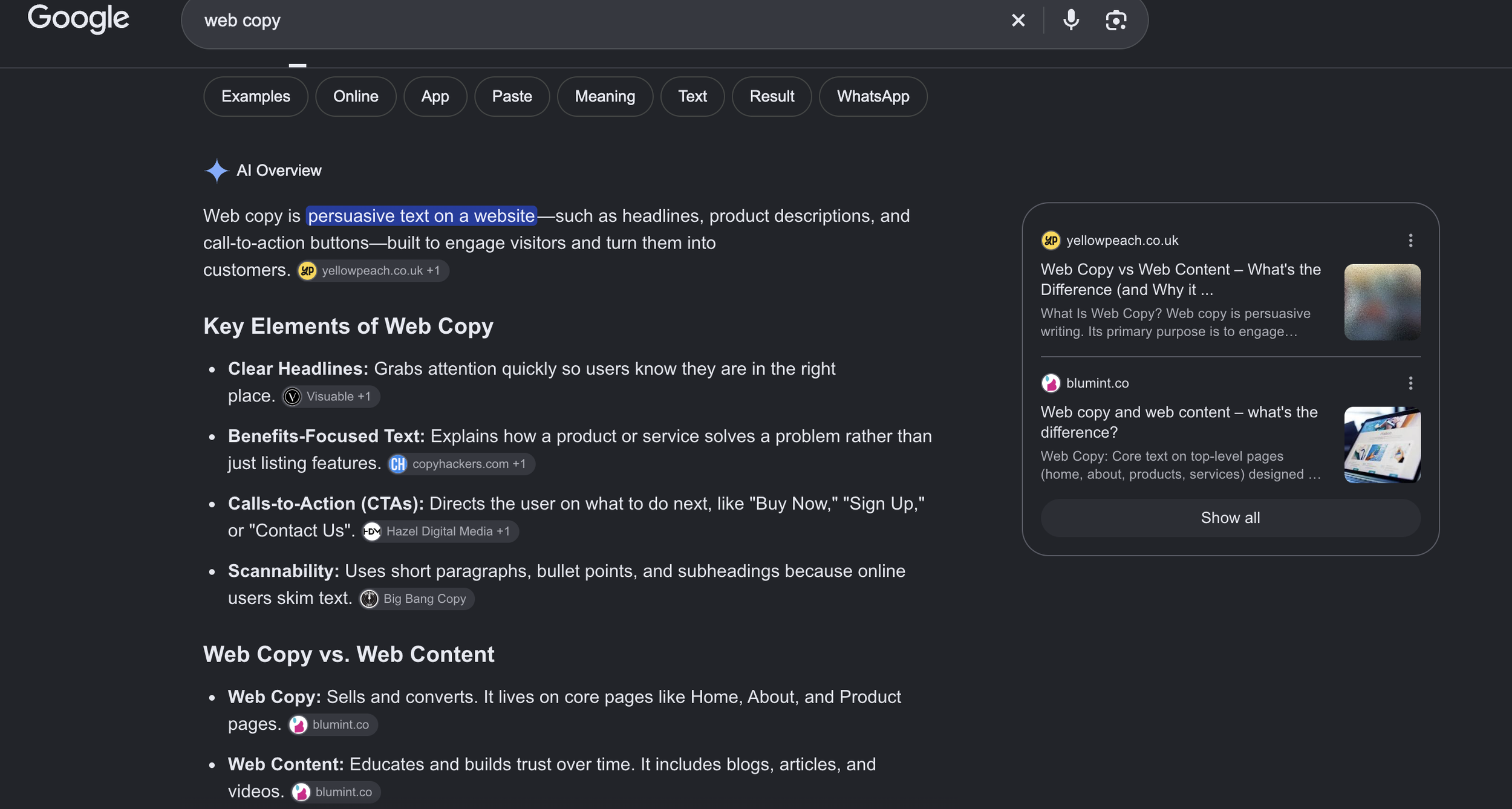
Blu Mint article on web copy and web content being cited in AI overview.
#5 Optimise for Voice Search
Voice search is how people ask questions to their phones, speakers and now AI assistants. I have no evidence from client work that it sends traffic.
The habit behind it still applies. People ask complete questions, whether typing or speaking, and AI assistants answer in plain language. SEO experts optimise for this by ensuring content appears in a featured snippet (see step #4) and by writing answers to full questions in plain words, with the answer first. Our piece on generative engine optimisation explains how this changes content.

#6 Aim for topical, in-depth, written content and context with keyword research
Previously,, search engines analysed pages to see how often a specific keyword was used and whether it appeared in certain tags and images, known as technical or on-site SEO. For example, your page would be crawled to determine whether your target keywords appeared in the following.
Title tag
URL
Meta description
Image ALT text
H1/H2/H3 tags
This is still important; however, search engine crawlers are getting smarter. Not only do they measure the content of your web page, they also measure the context. This means that to avoid showing shallow content to visitors, search engines now check whether the page shows in-depth knowledge of the topic.
To write comprehensive, in-depth content, plan around topics and not single keywords. One page can cover several related keywords and the questions around them, and I would rather publish one thorough page than several thin pages chasing near-identical terms. For most clients we recommend six articles a month of around 1,500 to 2,000 words. Longer content works better as a pillar page or a guide. Google does not count words, and John Mueller said in 2020 that matching the length of top-ranking pages will not make yours rank first.
You will still see advice to add LSI (Latent Semantic Indexing) keywords. Google doesn’t use LSI, and John Mueller has said LSI keywords don ’t exist. Ahrefs explains why. What works is covering the related terms and questions a topic needs. Read the pages that already rank, list what they cover and find what they leave out.
Google's guidance on helpful content asks whether a page shows first-hand expertise and offers original information other sites don’t, and it says trust matters most among experience, expertise, authoritativeness and trust. This has made the biggest difference to my results. My content gets cited in AI answers, and I put that down to well-written pages with a great deal of effort behind them, including my own experience, and not to formatting alone. Put a real author on every article, say what you did and what happened, and use examples from your own work.
Using AI to draft does not change that. Google says to fact-check and review AI output before you publish, and the first-hand experience still has to come from you. The speakers at BrightonSEO San Diego stressed the same point, and I wrote up the talks on AI search at BrightonSEO. Our guides to long-form and helpful content, and to human and AI content production, go into more detail, and our content writing team builds pages this way.
#7 Optimise your URL structure
Descriptive, keyword-relevant URLs have been an effective SEO strategy for years, and shorter URLs are easier to read and share. Google recommends readable words with hyphens between them and sets no length limit, so the rules below are my own habits, not Google requirements.
Remove stop words like ‘a', ‘of' and ‘the' to keep URLs short. When possible, put your primary keyword in the first few words of the URL, make sure it matches the search term, and keep the URL to five words or fewer.
Never put numbers or years in a URL. A page you update each year should not carry an old date in its address. Do not change the URL of an existing page either. When you have to, redirect the old address with a 301 to the closest equivalent page and never to the homepage, because a changed URL without a redirect throws away the links and history the page has earned. Our guide to website migration SEO risk explains what happens to traffic when URLs change without a plan.
If you run several country versions of a site, plan the URL and hreflang setup early. Our guide to international SEO for DACH explains when Germany, Austria and Switzerland need separate treatment and when one German version is enough.
#8 Structured data and Schema.org
To read websites, search engines need to understand them easily. Google is pretty good at analysing the context of a website’s content. When it comes to reading a page, search engine crawlers usually need some assistance to find the most valuable information for a searcher.
Structured data is data you add to your website to make it easier for search engines to understand. Optimise each blog post for structured data to improve its visibility and relevance in search results.
Structured data is a general term for organised data that conforms to a specific format. It is not only for SEO. When search engines read your website, they want to know if a piece of content is relevant, whether it is a job advertisement, a blog article or a product offering.
If you want rich results or a listing in Google’s knowledge graph, you’ll need to mark up your pages with Schema.org. If you're not comfortable with code, this can be daunting, so use a plugin or ask a developer to add JSON-LD, the format Google recommends.
My default is sitewide Organization markup, plus review, founder and event markup where the content supports it.
Google keeps trimming the rich results that markup can earn. It limited FAQ rich results to government and health sites in 2023, and its documentation says they stopped appearing on 7th May 2026. I still write FAQ sections because readers and AI answers use them, although I no longer add FAQ markup for rich results. Check that Google still shows a feature before you build markup around it.
Correctly implementing structured data might not improve rankings; however, it helps search engines and AI systems understand your pages. Google says you need no special markup to appear in AI Overviews or AI Mode, and that any markup must match the visible text. If you sell products online, AI shopping agents read structured product data, and our agentic commerce guide covers how to prepare your store. Ahrefs provides more detail about structured data and its benefits.
Source Schema.org Organization
#9 Adding video to your SEO strategy
People's demand for video content keeps growing. Platforms including Instagram, TikTok and Facebook push video higher in their feeds. And that's not to mention YouTube, which is a search engine in its own right.
YouTube is growing fast, people are taking to the video platform for entertainment and for “how-to videos” for a range of topics from how to wire plugs to user tutorials for software.
YouTube then, is a search engine that is too big to ignore as part of your SEO strategy. You've probably noticed that YouTube videos appear in your search results. It also ranks among the most cited sources in AI answers, and one 2026 index of AI citations that pulls together six studies puts it third.
The main takeaway is to embed videos in your content with a transcript and accurate captions so viewers stay on your website longer. I have produced video for some clients. I cannot show you a clean before-and-after for rankings, so I will not claim one.
Our guide to video SEO covers the practical steps, and our social media team handles distribution.
#10 Link building
Links have been one of the most important ranking drivers for years, significantly increasing organic traffic.
In the past, it was easy to obtain links by buying them from so-called “link farms” that would add your website domain to their websites. Google quickly caught on and “blacklisted” this practice. Google’s spam policies now treat buying or selling links for ranking as link spam unless you qualify the link with nofollow or sponsored. (Again, don’t try to cheat the system.)
Genuine backlinks are powerful for increasing domain strength.
Higher-ranking domains linking to websites act as a “vote of confidence”, passing on what Moz calls “link juice” and thus increasing the domain strength of that website. Google treats nofollow, sponsored and UGC attributes as hints, not strict rules. Higher domain strength increases URL strength, which helps in SERPs when people search.
If your content is not relevant or competitive, even adding high domain links won’t help your ranking so leave poor-performing content alone. If your content is stuck on the lower echelons of page 1 of Google, high-quality backlinks could push it higher.
Digital PR is what works best for me. Original data, expert comment and stories that journalists and industry publications want to cover earn links from sites that count, and those same mentions feed the sources AI systems draw on.
Google's AI optimisation guide says seeking inauthentic mentions across the web isn't as helpful as it might seem, so earn coverage with work that deserves it. Guest posts worked for me in the past. They now look spammy and carry risk, and Google’s spam policies list large-scale guest posting campaigns with keyword-rich anchor text as link spam.
Our articles on content distribution and brand visibility in LLMs show how to earn coverage.
#11 Local SEO is a must
Given the move toward a mobile-first mind-set, it's no surprise that many experts are placing increased emphasis on local search these days. If a website has a local presence, like restaurants, then appearing in local mobile searches is a must.
More customers are using mobile to find local businesses, products and information, so ranking for local keywords is essential.
Google's 3 pack at the top of searches displays the top 3 results dependent on the localised search term. The move to the 3 pack was to better satisfy mobile browsing and include maps and reviews of local businesses. Google says local results depend on relevance, distance and prominence, and that you cannot pay for a better local ranking. Prominence draws partly on links and reviews, so claim and verify your Business Profile, keep every detail accurate, and collect and answer reviews. Adding location and contact details to your website is still vital to appear in these results.
Our local SEO services cover the setup.
Local intent reaches beyond maps.
For Aspire and FieldRoutes, two US SaaS companies, I wrote state-by-state guides for landscaping and pest control businesses, such as the Alabama landscaping business licence guide. Each one answers a question that depends on where the reader operates. I describe the content marketing programme behind them for field service software.
#12 User intent is king
You've probably heard that “content is king”. However, user intent is king. As the relationship between keywords and rankings weakens, optimising for intent becomes even more crucial.
A strong SEO strategy means focusing not just on specific keywords and writing entertaining, engaging and valuable content, but also on the motivation behind those words and that content.
What are people actually looking for when they use those search queries?
When they click on a search result, will they get the information they wanted?
Can they navigate the website easily to find other information?
Is it easy for them to complete an action? Whether it's to buy a product, sign up for an email list, or share a piece of content.
Think about which keywords drive conversions and not just traffic. Search engines want to show visitors something relevant to a specific search query.
Before I write, I look at the results page. If it shows comparison tables, I write a comparison. If it shows steps, I write steps. I cover several keywords on one page when they share an intent and split pages when they do not. Questions are also getting longer and more conversational, because people type them to AI tools as well.
Buyers also rarely decide from one search.
A B2B buyer, a government procurement team and a consumer will each see your name in Google results, an AI answer, a LinkedIn post, a review site or a colleague's recommendation before they enquire.
Many B2B buyers form a shortlist before they speak to anyone, and our piece on how we approach fast B2B client acquisition explains why useful content shapes that list.
The aim is no longer to win a click from every content page.
It is to appear as one of several touchpoints in that decision, so measure rankings and impressions in Search Console, AI citations for a fixed list of queries, branded searches, direct visits and enquiries. Google counts AI Overviews and AI Mode traffic under the Web search type and doesn’t break it out.
Our guides to AI citation tracking, ChatGPT's own search index, content marketing ROI and enterprise SEO ROI show how.
Putting your strategy into practice
None of the tactics and tips mentioned above is anything new or even surprising. Experts have been implementing these strategies to boost rankings in response to the rapidly changing nature of SEO.
If you're planning to implement a strong SEO strategy now, then incorporate these steps into your planning.
Or contact our SEO team for more advice.